When One Wallet Owns Everything: Whales, Rugpulls, and the Concentration Problem
The word "whale" suggests size, but the real risk is not size. It is concentration. A token where a single wallet controls a majority of the supply is not a market. It is a position held by one person, and every other holder is along for whatever ride that person decides to take. When the whale sits still, the market looks calm. When the whale moves, everyone else is collateral damage.
Most of the worst launch disasters of the last few years trace back to this same structural property. Rugpulls are often just the cleanest form of it. Pump and dumps are a slower version. Even projects with no malicious intent can collapse if a single holder, or a small set of connected holders, ends up with enough supply to move the chart alone.
This article is about how that concentration forms, what the data says about its consequences, the difference between healthy and dangerous concentration, and why the fix has to start at the launch layer rather than the enforcement layer.
Concentration Creates Single-Point Failure
A healthy market has many independent participants making uncorrelated decisions. A concentrated market has one participant making the decision that matters. When that participant decides to sell, the rest of the market has no counterweight.
Data from Arkham Intelligence and on-chain explorers like Etherscan shows that top-10 holder concentration varies enormously across tokens, with many newer launches exhibiting extreme concentration patterns where a small number of wallets hold the vast majority of supply. Those tokens do not fail because the holders are malicious. They fail because their entire price depends on the behavior of a handful of addresses, and that is not a market.
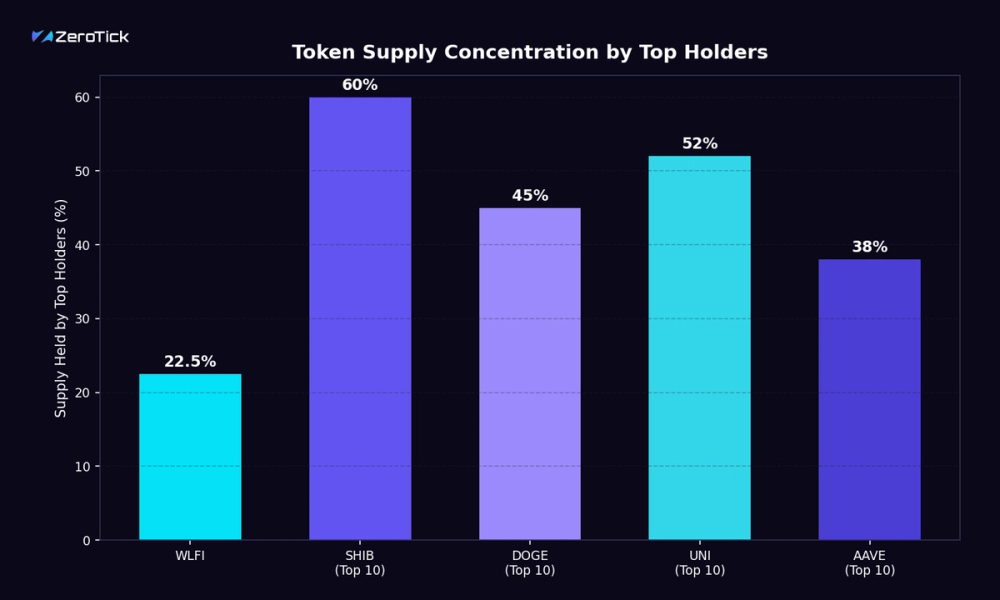
Top-10 holder concentration varies widely by asset. Extreme concentration creates structural risk that single-wallet actions can move entire markets.
Source: Arkham Intelligence, Etherscan
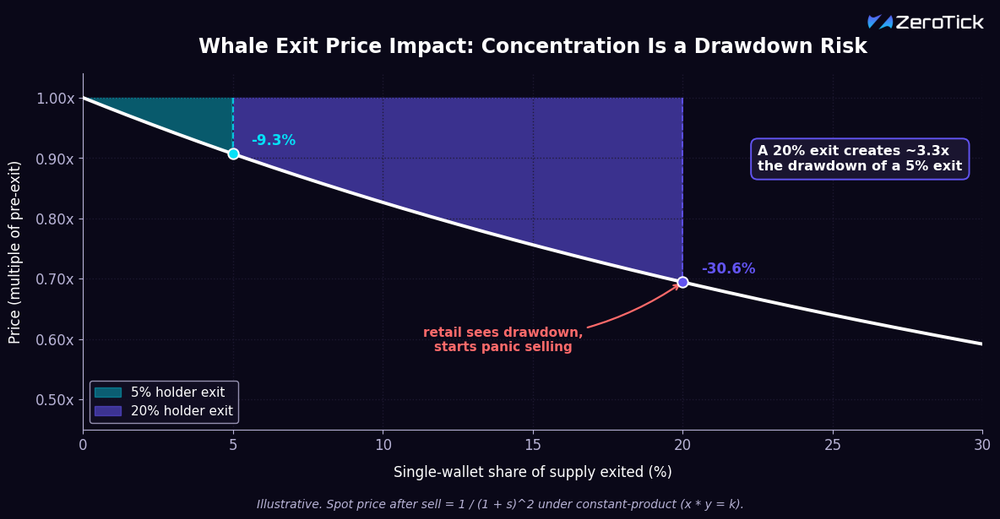
The research frame to keep in mind is simple. Concentration is not a symptom of a failed project. It is a structural property that makes failure far more likely.
Healthy Concentration vs Dangerous Concentration
Not all concentration is the same, and conflating the two is one of the more common mistakes in retail token analysis. The question is not whether a token has whales. The question is what kind of whales they are and what constraints they operate under.
Healthy concentration tends to look like this. The top wallets are identifiable as exchange custody addresses, recognized institutional holders, or known team and treasury addresses with public vesting contracts behind them. The supply they hold is bound by rules they cannot quietly renegotiate. Their potential selling pressure is calibrated to the daily volume the market can absorb. Independent analysts can verify the position by looking at the chain.
Dangerous concentration looks like the opposite. The top wallets are unattributed and freshly funded. The supply has no on-chain unlock schedule. The potential selling pressure dwarfs daily volume by an order of magnitude. The pattern of funding ties the wallets to a single source, suggesting that what looks like ten holders is one entity holding ten buckets. None of these properties are visible from a price chart, but all of them are visible on-chain to anyone willing to look.
The reason the distinction matters is that healthy concentration is usually a sign of a maturing market, while dangerous concentration is a sign of a market that has not yet been distributed. The first is a phase to grow through. The second is an unexploded device. Treating them as the same thing is what makes retail buyers susceptible to launches that look fine on the surface but are structurally identical to the ones that already failed.
Rugpulls Are the Clearest Case
A rugpull is the extreme end of the concentration problem. It is what happens when a single actor or a connected set of actors holds enough supply to fully exit the market at will, and then does exactly that.
Chainalysis tracks rugpull losses across years in its annual crime reports, and the pattern is consistent: rugpull losses have grown each year alongside launch activity, and the largest single events are almost always tied to wallets that controlled majority supply before the exit. The most recent edition of the Chainalysis report documents the scale of these losses and the concentration profiles that preceded them.
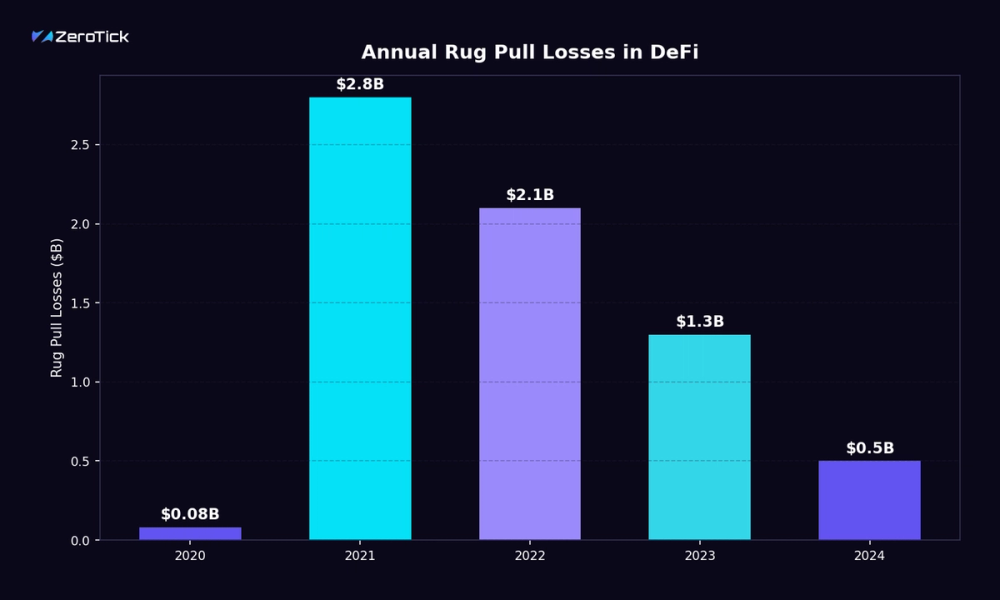
Rugpull losses have grown each year alongside launch activity, with the largest single events tied to wallets controlling majority supply.
Source: Chainalysis 2025 Crypto Crime Report
The uncomfortable implication is that rugpulls are not primarily a fraud problem. They are a concentration problem with fraud layered on top. A rugpull is only possible because a single actor held enough supply to execute one. If concentration had been capped at launch, even a bad actor would not have had the ammunition to rug. The connection to the insider advantage failure mode is direct: insider clusters are the fastest path to concentrated supply, and concentrated supply is the precondition for the most damaging launch outcomes.
The Pump and Dump Is the Slower Cousin
Not every concentrated launch ends in an overt rugpull. Many of them end in a drawn-out distribution that looks more polite but produces the same outcome for retail buyers. A whale accumulates cheaply, a marketing wave brings in retail demand, and the whale distributes gradually into that demand. The chart looks like natural volatility. The outcome is one wallet getting richer while many small wallets get poorer.
This pattern is harder to call out because it does not have a single dramatic moment. But the math is the same. A concentrated holder distributes supply into less-informed demand, and the price settles at whatever level retail is willing to hold the bag at. The concentration is the fuel. The marketing is just the match.
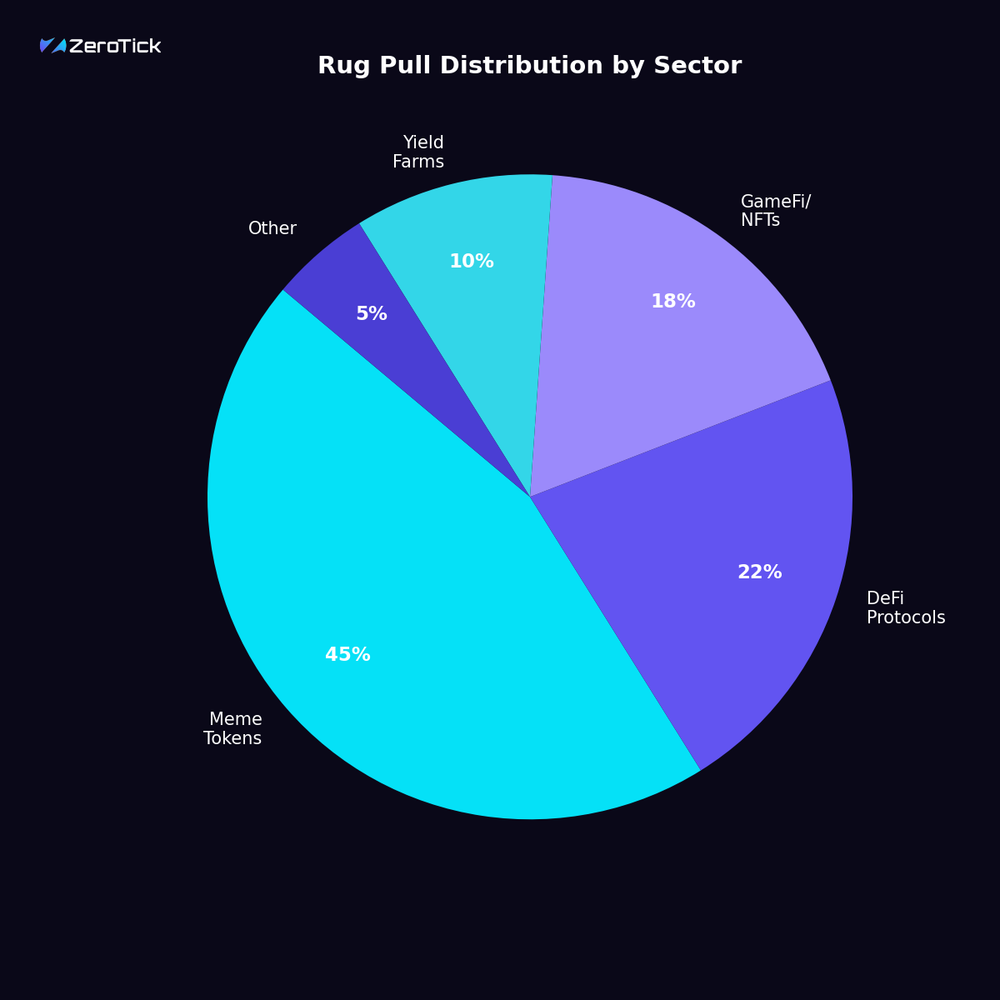
Memecoins and micro-cap tokens account for the majority of rugpull incidents, reflecting weaker launch controls on high-velocity assets.
Source: Chainalysis, Web3 Is Going Great
The distribution across sectors tells you where the concentration risk is most acute. Memecoins and micro-cap tokens dominate rugpull incident counts, according to Chainalysis and Web3 Is Going Great, which tracks public crypto failures. These are exactly the categories with the weakest launch controls, which is not a coincidence.
Why the Fix Has to Happen at Launch
Once concentration exists, it is almost impossible to fix. You can ask holders to distribute. You can plead on social media. You can launch new marketing campaigns. None of this changes the on-chain reality that a single wallet can still move the market.
The only intervention that actually works is preventing extreme concentration from forming in the first place, which means acting at the moment of launch. Three launch-layer protections reduce concentration risk meaningfully.
The first is per-wallet purchase caps during the protected launch window. If no single wallet can buy more than a small share of supply in the opening block, coordinated concentration becomes significantly harder, because it now requires dozens or hundreds of independent wallets acting together instead of one.
The second is transparent allocation structures with smart-contract-enforced vesting. Our vesting article goes into the details, but the core point is that visible, time-bound allocations prevent a single holder from exiting at the moment of their choice. Concentration with no exit path is far less dangerous than concentration with an unlocked position.
The third is on-chain reporting that surfaces concentration to any buyer in real time. When a new buyer can see at a glance that a token has extreme concentration, the buyer can choose to stay out. The problem right now is not that the data is hidden. It is that it is not surfaced at the moment the decision is being made. Better tooling from projects like Bubblemaps is closing that gap, but the responsibility also sits with launch platforms to display this information prominently.
A Practical Evaluation Checklist
Before you evaluate a token by its price chart, run through a short concentration checklist. It takes a few minutes and it filters out the worst categories of risk before you ever click buy.
Start with the top-10 holder share. If a single wallet holds more than ten percent of supply, the token is exposed to that wallet's decisions. If the top ten hold more than fifty percent, the token is exposed to a coordinated decision by ten or fewer parties. Either of those is a yellow flag. Both together are red.
Next, look at funding. Are the top wallets funded by a recognized exchange address, by an attributed institutional custody, or by a single unattributed source? The first two suggest a distributed market. The third suggests a clustered insider position. Tools like Bubblemaps make this distinction visible without specialist skills.
Then, look at vesting. If the top wallets are bound by an on-chain schedule, the worst-case selling pressure is bounded. If they are not, there is no upper limit on what they can do at any given block.
Finally, look at the launch design itself. Did the launch enforce per-wallet caps at block zero? Was there a protected opening window? If neither answer is yes, concentration was free to form in the very first transactions, and everything downstream is a consequence of that.
How ZeroTick Fits
ZeroTick's V1 launch framework treats concentration as a launch-layer design parameter rather than a post-launch problem to monitor. Advanced Launch ships three optional protections that directly constrain how much supply any single wallet can accumulate during the bonding curve phase. Anti-Whale caps total token accumulation per wallet. Buy Limits cap each purchase in USD, with presets at $500, $1,000, and $1,500 per wallet per purchase. Sell Limits cap the maximum size of each sell transaction, which is the specific countermeasure to dump-and-dash tactics where a whale cashes out at peak and leaves every other holder with the crash. All three are enforced at the smart-contract level for the entire bonding curve phase, and once a protection is active it cannot be bypassed or changed mid-launch.
These caps sit on top of the default Serialized Trade Execution (Anti-Bundle), which prevents any multi-wallet Sybil cluster from being batched into a single atomic transaction, and on top of always-on Anti-Insider protection, which blocks pre-launch contract address leaks that would let a whale build a position before anyone else can react. For project allocations, Advanced Launch supports smart-contract vesting across five bucket types (Marketing, Community, Project Development, Team, and Other), with cliff periods up to 12 months, vesting periods up to 24 months, and release intervals from weekly to quarterly. Team tokens cannot be dumped the moment the token graduates to a DEX. They are released on a transparent, pre-set schedule any holder can verify before buying.
Transparency is the final layer. Every Marketplace project card surfaces Dev Holding, Top 10 Holders, Insider Holding, Sniper Holding, and Bundler Holding percentages in real time. A would-be buyer can see the concentration state of a token before committing capital, and the Marketplace supports filtering by protection level so users can favor launches with stronger safeguards. Once a token graduates from the bonding curve to an external DEX, these protections no longer apply and standard DEX trading rules take over, which is why the evaluation checklist above still matters even for launches that sit on a protected venue. This article is educational content, not financial or investment advice.
Conclusion
Concentration is the quietest of the launch problems. It does not have the drama of a sandwich attack or the visibility of a public rugpull. But it is the soil in which almost every other launch failure grows. When you evaluate a token, do not start with the price chart. Start with the holder distribution. Look at the top 10. Look at the vesting. Look at whether the launch had per-wallet caps at block zero. Those three answers tell you more about the risk than any amount of narrative.
Follow the ZeroTick approach at the ZeroTick documentation and the ZeroTick blog. This article is educational and is not financial advice.