Hyperbridge Gateway Exploited: How an Attacker Minted 1 Billion DOT on Ethereum for $237K

TL;DR
A forged state proof bypassed Hyperbridge HandlerV1 verification, letting an attacker take over the bridged DOT token contract on Ethereum, mint 1 billion tokens (2,805x the circulating supply), and swap them for 108.2 ETH (~$237K) through Odos and Uniswap V4.
A Single Transaction, $237K Gone: Inside the Hyperbridge DOT Exploit
At 03:55 UTC on April 13, 2026, an attacker executed one of the most technically precise bridge exploits of the year. In a single transaction, they forged a cross-chain message from Polkadot, hijacked admin control of the bridged DOT token contract on Ethereum, minted one billion tokens (roughly 2,805 times the entire circulating ERC-20 supply) and dumped them across decentralized exchanges for 108.2 ETH, worth approximately $237,000.
The target was Hyperbridge, a cross-chain interoperability protocol built by Polytope Labs and positioned as one of the Polkadot ecosystem flagship bridges. The irony is hard to miss: Hyperbridge was specifically designed to eliminate the trust assumptions that have made bridges crypto most exploited attack surface. Its core promise, "proofs over promises," relied on cryptographic state verification instead of the multisig committees that have failed so many times before. Today, that promise was tested and found wanting.
The exploit was confirmed on-chain in block 24868295 with 241 block confirmations. The full transaction is publicly viewable on Etherscan.

What Is Hyperbridge and Why Does It Matter?
Before dissecting the exploit, it helps to understand what Hyperbridge is supposed to do. Cross-chain bridges are the connective tissue of multi-chain DeFi. They let you move assets from one blockchain to another, in this case, moving DOT from Polkadot to Ethereum as an ERC-20 token.
Bridges have historically been crypto soft underbelly. The Ronin Bridge hack ($625M, 2022), Wormhole ($320M, 2022), and Nomad ($190M, 2022) demonstrated that bridge exploits are not edge cases. They represent some of the largest losses in DeFi history. According to DefiLlama data, bridge exploits have accounted for over $2.8 billion in cumulative losses since 2020.
Hyperbridge, built on the Interoperable State Machine Protocol (ISMP), was designed to be different. Instead of trusting a small group of validators or a multisig wallet to attest that a cross-chain message is valid, ISMP uses cryptographic state proofs. The idea is straightforward: rather than asking someone to vouch for a message, you verify it mathematically against the source chain consensus state. In theory, this is strictly more secure. In practice, the implementation left a gap the attacker drove straight through.
The Attack: Step by Step
Blockchain security firm CertiK was among the first to flag the exploit. Here is how the attack unfolded, reconstructed from on-chain data and CertiK analysis.
Step 1: Contract Deployment
The attacker deployed two smart contracts in a single transaction, a master contract and a helper contract. This is a common pattern in DeFi exploits: the master coordinates the attack logic while the helper handles the specific interactions with the vulnerable protocol. Both contracts were created within the exploit transaction itself (tx hash: 0x240a...1109), making the attack atomic. Either everything succeeds, or nothing does.
Step 2: Forging State Proofs
The helper contract submitted forged state proofs to Hyperbridge HandlerV1 contract (deployed at 0x6c8...4E6D64). This is the critical vulnerability. The HandlerV1 contract is responsible for verifying that incoming cross-chain messages are legitimate, that they actually originated on the source chain and were included in a finalized block. The attacker forged proofs bypassed these verification checks entirely.
In a properly functioning system, a state proof for a Polkadot-to-Ethereum message would need to prove inclusion against Polkadot relay chain state root. The attacker crafted a proof that the HandlerV1 contract accepted as valid despite not being anchored to any real Polkadot state. This is the root cause: insufficient validation in the ISMP proof verification pipeline.
Step 3: Admin Takeover via ChangeAssetAdmin
With the forged proof accepted, the attacker malicious message was processed through the TokenGateway.onAccept() execution path. This path handles legitimate cross-chain governance actions, including a ChangeAssetAdmin action that can transfer administrative control of a bridged token contract. The attacker used this action to transfer admin and minter privileges of the bridged DOT token contract (0x8d...8F90b8) to their own address.
Step 4: Minting 1 Billion DOT
With admin control secured, the attacker minted 1,000,000,000 DOT tokens. To put this in perspective, the total circulating supply of bridged DOT on Ethereum was approximately 356,000 tokens before the attack. The attacker minted roughly 2,805 times the entire supply in a single call.
Step 5: Liquidation Through DEX Routing
The attacker then swapped the freshly minted tokens through two decentralized exchange protocols. The routing went through Odos Router V3 and Uniswap V4 pool contracts, converting the unbacked DOT tokens into 108.2 ETH, approximately $237,000 at the time of the transaction. The ETH was received at the attacker EOA: 0xC513E4f5...F1F8E7. The transaction fee for the entire operation was just $0.74.
Not the First: An Earlier Exploit Hit the Same Day
Reports indicate this was actually the second exploit of Hyperbridge contracts on the same day. An earlier attack, using a similar vector, reportedly drained approximately $12,000 in MANTA and CERE tokens. The smaller exploit may have served as a proof of concept or been executed by a different attacker who noticed the same vulnerability. Either way, the fact that the vulnerability was exploited twice before any mitigation was deployed raises serious questions about Hyperbridge monitoring and incident response capabilities.
Market Impact and Exchange Response
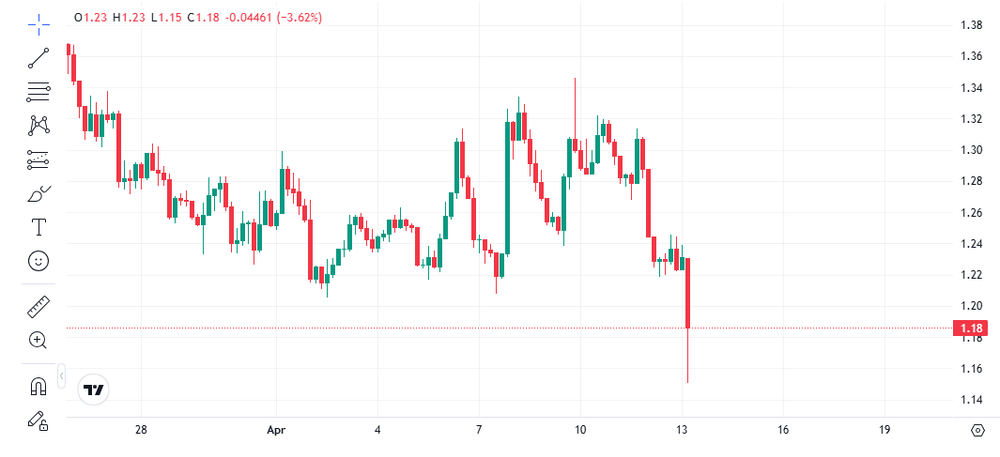
The immediate fallout was swift. Following the exploit, the native DOT token on Polkadot dropped approximately 3.62%, falling from $1.23 to a low of $1.15 and closing at $1.18. While the exploit only affected the bridged ERC-20 representation of DOT, not the native token on Polkadot relay chain, the market reaction was predictable. Fear, uncertainty, and doubt spread quickly.
South Korean exchanges Upbit and Bithumb moved to suspend Polkadot deposit and withdrawal services as a precautionary measure. This is standard practice when a token bridge infrastructure is compromised, as exchanges need to verify that deposited tokens are legitimate and backed by actual reserves.
As of publication, no official statement from Hyperbridge or Polytope Labs has been widely circulated regarding the exploit, any contract pauses, or fund recovery efforts.
Why This Matters: The Bridge Security Problem Is Not Solved
This exploit is a case study in why cross-chain security remains DeFi hardest unsolved problem. Hyperbridge was not a hastily assembled multisig bridge. It was a protocol explicitly built to replace the trust models that had failed before, using cryptographic proofs instead of human attestation. And yet, the implementation of those proofs contained a flaw severe enough to allow unauthorized minting of billions of tokens.
The vulnerability was not in the cryptography itself. It was in the verification logic, the code that checks whether a submitted proof is valid. This is a pattern we see repeatedly in DeFi security incidents. The theoretical model is sound, but the implementation introduces assumptions or shortcuts that an attacker can exploit.
For traders and liquidity providers, the lessons are familiar but worth repeating. Bridged assets carry inherent risk beyond the underlying token. When you hold bridged DOT on Ethereum, you are not just exposed to DOT price. You are also exposed to the security of the bridge contract, the verification logic, the governance mechanisms, and the operational security of the team maintaining it. This is why platforms focused on protecting traders from exploitative on-chain behavior, including MEV protection and pre-trade risk analysis, are becoming essential infrastructure, not optional extras.
What Traders Should Do Right Now
If you hold bridged DOT (ERC-20) on Ethereum through Hyperbridge, exercise extreme caution. The minting of 1 billion unbacked tokens has likely destroyed the peg between bridged DOT and native DOT. Any bridged DOT you hold may be worth significantly less than the native token until Hyperbridge addresses the vulnerability, potentially burns the illegitimate supply, and restores confidence in the bridge.
More broadly, this incident is a reminder to diversify your bridge exposure. Do not hold significant value in a single bridged asset from a single bridge provider. Use bridges with proven track records, active bug bounty programs, and, critically, real-time monitoring that can pause operations before an exploit drains liquidity.
The Bigger Picture: Bridges Are Still DeFi Weakest Link
The Hyperbridge incident adds to a growing body of evidence that bridges remain the single most dangerous category of smart contract in DeFi. Even "trust-minimized" designs using cryptographic proofs are only as secure as their implementation. Until the industry develops more robust formal verification standards for bridge contracts and real-time proof validation, these exploits will continue.
For now, the $237,000 loss is modest by bridge exploit standards. But the mechanism, forging a state proof to hijack token governance, is deeply concerning. If the same vulnerability existed in a bridge with deeper liquidity, the losses could have been orders of magnitude worse.
This article is for educational and informational purposes only. It does not constitute financial advice. Always do your own research before interacting with DeFi protocols or bridged assets.