The Insider Advantage: How Pre-Launch Access Rigs Memecoin Launches
Every few weeks, a new memecoin goes vertical on a chart and a wave of retail buyers pile in. What they usually do not see is the pattern that preceded the rally: a cluster of wallets that were funded before liquidity was public, acquired supply at prices no public buyer could access, then exited into the first wave of retail demand. By the time anyone reads about the token, the outcome has already been decided.
The word "memecoin" suggests randomness, but on-chain data suggests the opposite. The majority of launch value on most venues is concentrated in a small number of wallets that did not participate fairly. This article is about how that concentration happens, what the data shows, how on-chain analysts actually detect it, and what launch infrastructure has to look like if the word "fair" is going to mean anything.
The Three Forms of Pre-Launch Access
Insider advantage on a launch is not one mechanism. It is a small family of them, each of which turns a public launch into a closed auction.
Pre-Funded Wallets
The most basic form of insider advantage is simply having tokens before public liquidity exists. This happens when a deployer airdrops supply to a set of addresses before the liquidity pool opens, when a team allocates to advisors without disclosing the addresses, or when a launch platform grants privileged access to its own treasury or partners. None of these are visible to a public buyer reading the launch announcement. All of them are visible on-chain if you know where to look.
Research from Chainalysis and visualization tools like Bubblemaps routinely surface launches where a cluster of connected wallets controls a disproportionate share of the initial supply before the first retail trade. Those wallets then sell into the opening wave, and the public is left holding the float.
Snipe and Bundling Collusion
Even when no allocation is pre-distributed, insiders can guarantee themselves the opening block by coordinating bundles with a friendly builder or validator. This overlaps with the bundle attack failure mode covered elsewhere in this series, but the underlying dynamic is the same: access to information or infrastructure that a retail buyer does not have, converted into an economic advantage at the moment the token becomes tradable.
Privileged KOL and Influencer Access
The third form is the least technical and often the most effective. A project pre-allocates tokens to influencers or their associated wallets in exchange for marketing, with no transparency about how much or when those allocations can be sold. The public sees a wave of enthusiastic posts. The influencer sees an unlock schedule on a contract they already hold. This is the softest form of insider advantage, and it is also the easiest to hide because the allocations can be disguised as OTC deals, affiliate programs, or undisclosed advisor grants.
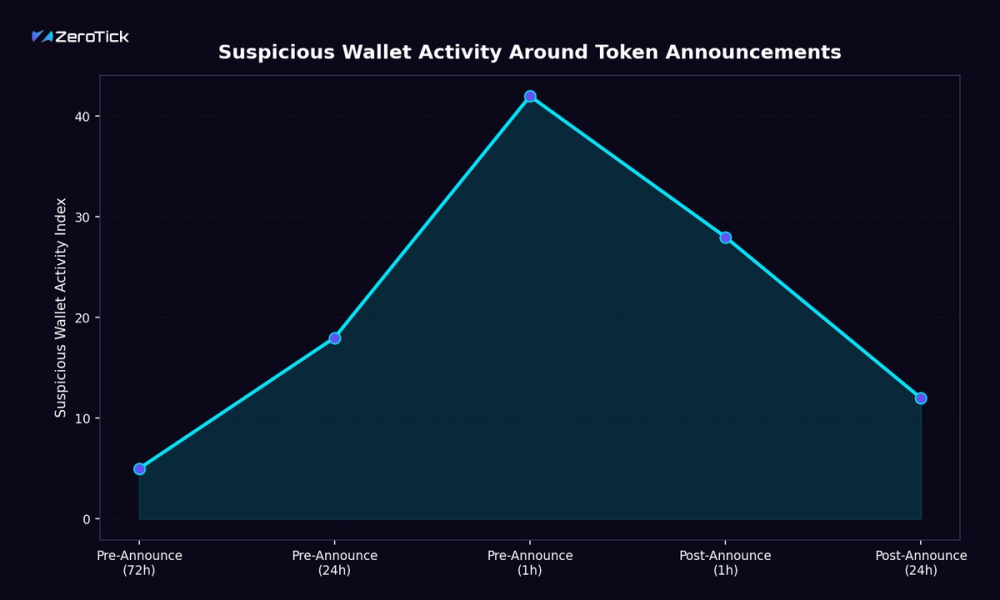
When insider wallets exit into thin order books, retail entrants typically face steep drawdowns within the first hours of trading.
Source: DEX Screener, on-chain launch data
How On-Chain Analysts Actually Detect It
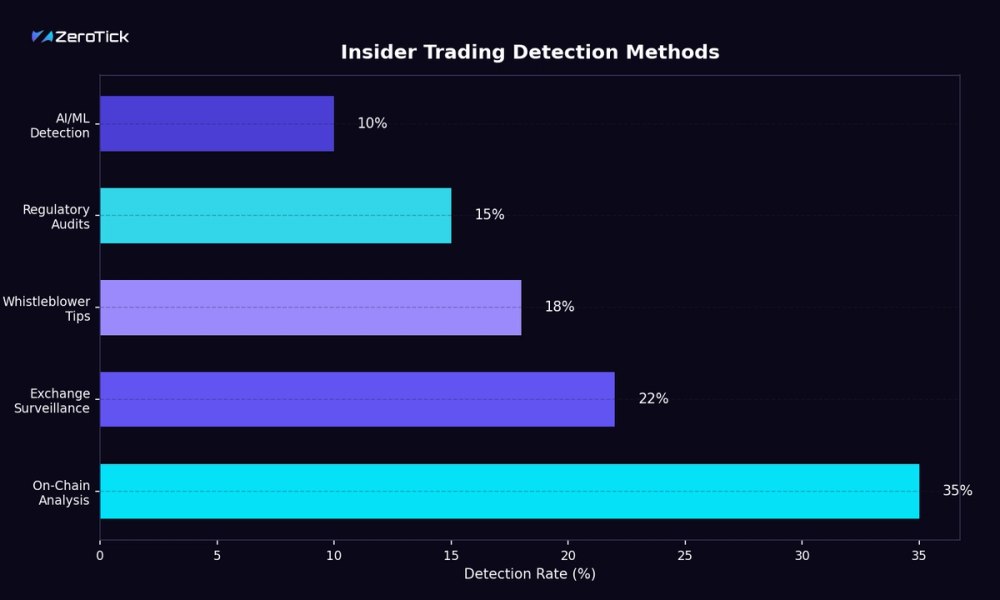
Most of the visible reporting on insider clusters comes from a small number of analytics tools, and it is worth understanding how they actually work. The detection problem is a clustering problem. A single insider rarely operates from one wallet, because one wallet is easy to dismiss. They operate from a cluster, and the cluster has fingerprints.
The simplest fingerprint is funding. When a set of addresses receives their first transaction from the same source within a tight time window, they are almost certainly related. Tools like Bubblemaps build their initial graphs by tracing exactly this pattern, and the visual outputs make the relationships immediately obvious to anyone who looks. A token whose top twenty wallets all trace back to a single funding address is not a market. It is one entity holding twenty buckets.
The second fingerprint is behavioral correlation. Insider wallets tend to act on the same signals at the same time, because they are often controlled by the same person or coordinated team. When ten wallets all sell within the same block window after the price crosses a threshold, that is not a coincidence. Arkham Intelligence and similar attribution platforms routinely flag these patterns as evidence of common ownership, and the resulting graphs are public for any analyst to verify.
The third fingerprint is funding path overlap. Even when a sophisticated insider tries to launder the connections through intermediate wallets, the paths often converge at known exchange deposit addresses or recognizable hot wallets. Public attribution makes this easier each year, and the cost of perfect operational security keeps rising.
The point of going through the detection mechanics is that the insider problem is not invisible. It is well understood, well measured, and the main reason it persists is that the surface where buyers actually make decisions, namely the launch platform itself, rarely surfaces this information at the moment of the decision.
On memecoin launches, insider-controlled wallets frequently capture a disproportionate share of the initial supply before public liquidity is available.
Source: Chainalysis, Bubblemaps launch analyses
What the Data Shows
Every analysis of the on-chain launch environment converges on the same shape. A small set of wallets disproportionately captures the first minutes of value, and a much larger set of retail buyers absorbs the losses.
Chainalysis and DEX analytics show that on sampled memecoin launches, insider-controlled wallets frequently capture a meaningful share of the initial supply before public liquidity exists. When those wallets exit into the first wave of retail demand, the order books are thin and the price impact is severe. Dashboards from DEX Screener and on-chain launch trackers show retail drawdowns that typically hit within the first hours of trading.
The pattern is not random. It is the predictable output of a system where the rules of access are different for different participants. As long as pre-launch access is possible and opaque, the math will keep working out the same way, and the relationship to broader whale concentration is direct: insider clusters are the fastest path to concentrated supply, and concentrated supply is the fastest path to a rugpull or pump-and-dump.
Why Warnings Are Not Enough
The standard response to this problem is to tell retail buyers to be more careful. Check the contract. Check the holders. Watch for red flags. This is not bad advice, but it is not a fix. The asymmetry between a sophisticated insider and an average buyer is not going to be closed by telling the buyer to read harder.
The real fix has to happen at the launch infrastructure layer. If the launch itself cannot be rigged, the warning is unnecessary. If the launch can be rigged, the warning is not enough. That is the line any serious launch platform has to reason about.
Three properties tend to show up in launch designs that actually narrow the insider gap.
The first is on-chain transparency of allocations. Every bucket of supply, including team, advisors, early backers, marketing, and community, should be visible on-chain before the launch is final. Platforms that publish contract addresses, allocation labels, and vesting schedules in a machine-readable form make it much harder to hide insider pockets, because independent analysts can verify the distribution in real time. This is a surface where the vesting protections covered elsewhere in this series do most of the work, because vesting and disclosure are two sides of the same constraint.
The second is anti-snipe protection at block zero. Even if allocations are clean, the opening block is still a target for bots and bundles. A fair launch has to neutralize the advantage of being first in the block, because otherwise the first block becomes a redistribution of ownership from retail to the fastest actor present. Our sniper bot article goes into this dynamic in more depth.
The third is equal access as a default. If any party has a privileged path to supply at a different price than the public, the launch is not fair, regardless of how the pitch is framed. A fair launch treats every participant as a public buyer, and any deviation from that has to be explicit and disclosed in advance.
How ZeroTick Fits
ZeroTick's V1 launch framework was designed around the insider problem as a first-class concern. The protection the docs call Anti-Insider is always active on every launch and cannot be disabled by anyone, including the creator. The contract address is hidden until the exact moment trading goes live, and all currently supported chains go live simultaneously. There is no staggered reveal, no creator-side early access, no chain-specific advantage. For both immediate and scheduled launches, the contract address stays hidden until the scheduled go-live moment, so the window insiders normally exploit for pre-funded buys simply does not exist. Anti-Insider is not a configurable setting. It is built into the platform.
The insider problem does not end at block zero, which is why V1 layers three further protections on top. Serialized Trade Execution (Anti-Bundle), enabled by default on every launch, prevents any cluster of insider wallets from being batched into a single atomic transaction, so a coordinated pre-funded group cannot clear the cheap end of the curve in one call. Advanced Launch adds optional smart-contract vesting for Team, Marketing, Community, Project Development, and Other allocations, with cliff periods up to 12 months, vesting periods up to 24 months, and release intervals configurable as weekly, bi-weekly, monthly, bi-monthly, or quarterly. Vesting is enforced by the contract, not by a project's promise, so any allocation, disclosed or not, is bound by a schedule any holder can verify before buying. Creators can also enable optional Buy Limits, Anti-Whale accumulation caps, and Anti-Bot filters on top of that baseline.
Transparency makes the outcome legible. Every Marketplace project card surfaces five real-time holder metrics: Dev Holding, Insider Holding, Sniper Holding, Top 10 Holders, and Bundler Holding. Insider Holding specifically surfaces tokens held by wallets flagged for insider activity, which is exactly the signal the on-chain analysts quoted earlier in this article look for. Users can filter the Marketplace by protection level, see green or red indicators on every project card, and verify protection state on the trading page before committing capital. V2 on the public roadmap adds commit-reveal intent hiding and VRF-randomized execution, which would close the residual ordering advantage that faster or better-informed parties currently retain. V2 remains in active research with no public timeline.
Conclusion
Memecoin launches are not uniquely corrupt. They are simply a high-velocity environment where the failure modes of public blockchain infrastructure are amplified. The insider advantage is a property of the launch venue, not a property of the token, and the way to close it is to change the venue.
When you evaluate a token launch, do not start with the logo or the narrative. Start with the allocation structure, the anti-snipe mechanism, and the vesting contract. If those three are opaque, the launch is already rigged. If those three are transparent and enforced on-chain, you are looking at something closer to fair.
Follow the ZeroTick approach at the ZeroTick documentation and the ZeroTick blog. This article is educational and is not financial advice.