Vesting Done Right: How Transparent Unlocks Protect Every Holder
The first hour of a token launch is the loudest moment in its life. The chart, the volume, the size of the opening pool. It is also the moment everyone watches most closely, which is exactly why it is rarely where the real damage happens. The damage usually happens months later, on a Tuesday morning that no one circled on a calendar, when the first unlock arrives and supply that was paid for at a fraction of the current price is suddenly free to sell.
Most failed launches do not fail at block zero. They fail at block N, where N is whichever block the cliff expires. By that point the founders have moved on to the next narrative, the influencers have moved on to the next ticker, and the late buyers are left holding a token whose float just multiplied. The launch was never the problem. The vesting was.
This article is about what vesting actually is, how it has been done so far, what is broken about the current approach, why it matters, and what a credible launch framework should offer instead. It also covers how ZeroTick treats vesting as a first-class protection rather than a footnote in a tokenomics PDF.
What Vesting Actually Is
Vesting is the contract between a project and its holders about when insider supply is allowed to move. The word itself comes from traditional equity, where employees earn ownership of stock options gradually instead of receiving them all at once. The point is to align incentives. If you walk away in three months, you do not take a full year's grant with you.
Crypto inherited the idea and the vocabulary, but not always the rigor. A typical token vesting schedule has two parts. The first is the cliff, a period during which no tokens can be claimed at all. The second is the linear stream, a period after the cliff during which tokens unlock gradually until the full allocation is released. A common shape for a team allocation might be a six-month cliff followed by a thirty-six-month linear unlock.
The intent is straightforward. You want the people who built the project, raised for it, and were given supply at favorable prices to be exposed to the same long-term outcome as the people who bought on the open market. A well-designed vesting schedule means insiders cannot exit before the project has had time to prove itself, and means their selling pressure is spread out instead of concentrated into a single distribution event.
Vesting applies to more than just teams. It applies to early backers, advisors, ecosystem partners, treasury allocations, and increasingly to influencer and KOL deals. Anywhere supply is granted at a price below what the public will eventually pay, vesting is the mechanism that keeps the grant honest.
How Vesting Has Been Done So Far
For most of crypto's history, vesting has been enforced the way it is enforced in traditional finance: with paper. A legal agreement specifies the schedule. A multi-signature wallet holds the tokens. A team member or law firm releases the tranches manually as the schedule progresses. Auditors review the process, and trackers like TokenUnlocks and CryptoRank compile community-readable calendars from whatever public information projects share.
The smart-contract version of this exists, and has for years. Templates from OpenZeppelin and equivalent libraries provide standard vesting wallet contracts that lock supply against a deterministic release curve. Many projects use them. Many do not. The choice between contract enforcement and off-chain enforcement is one of the most consequential tokenomics decisions a launch makes, and it is also one of the least visible to the average buyer.
Where on-chain vesting is used, the schedule lives in code and the release happens automatically. Where off-chain vesting is used, the schedule lives in a legal document and the release happens by manual transaction. Both approaches can work in good faith. Only one of them can be verified by an outsider in real time.
The honest description of the historical environment is that vesting has been a mix. Some projects ship rigorous on-chain enforcement from day one. Some publish a tokenomics chart, hold the supply in a multi-sig, and rely on trust. Some quietly renegotiate the schedule mid-cycle when conditions change. The buyer typically cannot tell which category a project is in until the first unlock arrives, and by then the answer no longer matters.
What Is Broken About the Current Approach
The core problem with off-chain vesting is that it is a promise rather than a constraint. A promise can be honored, but it can also be revised, missed, or selectively enforced, and the people who are most exposed to a missed promise have the least power to stop it.
Four failure patterns show up repeatedly. The first is quiet renegotiation. When market conditions or internal politics change, an off-chain schedule can be rewritten in private and the holders affected by the change have no notice and no recourse. The second is information asymmetry. Insiders know the actual schedule. The public sees a marketing chart. When the two diverge, the divergence is invisible until the unlock arrives. The third is slow legal remedies. Even when an off-chain schedule is broken in obvious bad faith, the legal path to recovery is slow, expensive, and jurisdictionally fragmented. The unlock happens at the speed of a block. The lawsuit takes years. The fourth is the structural mistake of designing schedules that look reasonable on paper but release supply at a rate the market cannot absorb. A six-month cliff sounds responsible until the day after the cliff, when the unlock is several multiples of average daily volume.
Data from TokenUnlocks shows token prices tend to weaken in the weeks leading into scheduled unlocks and recover only partially afterward, which is exactly the pattern you would expect if the market is pricing in a supply shock that no one can negotiate away. The schedule is the schedule, and the chart is the chart, and they are both reading the same future.
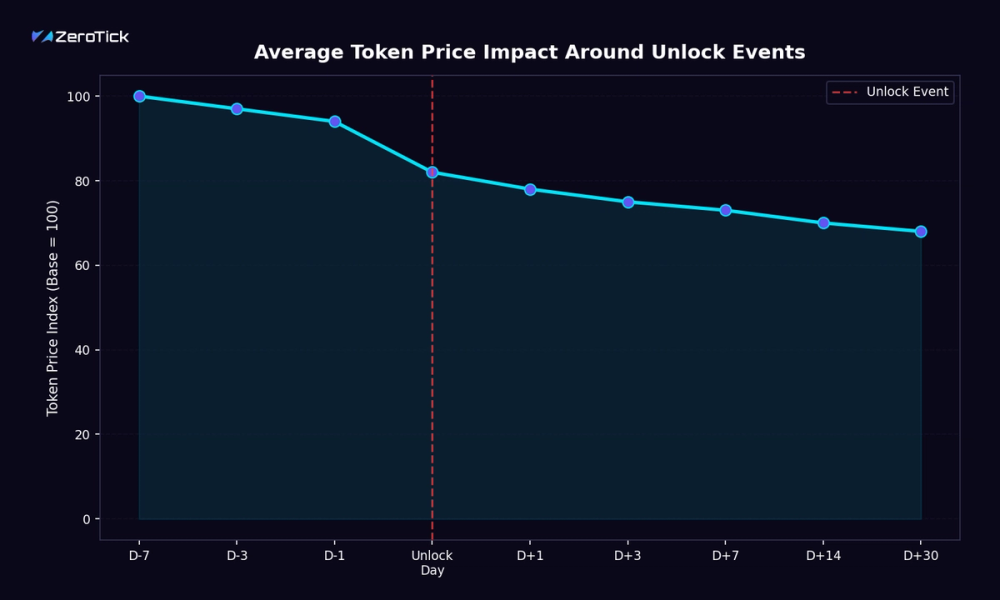
Token prices tend to decline into unlock events and recover only partially afterward, revealing the market impact of predictable supply releases.
Source: TokenUnlocks, CoinGecko
The structural mistakes are usually one of four patterns. A cliff that is too short. Linear streams that release too much supply at once relative to daily volume. Opaque off-chain enforcement. And asymmetric treatment of participants, where team, investors, advisors, and the public are subject to rules that were never disclosed transparently. Each of these gets locked in at launch, and by the time the first unlock arrives it is too late to fix.
Why It Matters
The case for taking vesting seriously is not philosophical. It is about the three things that get destroyed when vesting fails.
The first is price. Predictable supply pressure becomes priced in well before the unlock arrives, and the market discounts the token in advance. Holders who never sold a single share end up paying the cost of insider unlocks they had no part in.
The second is trust. A project that mishandles its first unlock spends the rest of its existence trying to recover credibility it can no longer prove. Communities have very long memories about distribution events. The damage is rarely a single event. It is a permanent ceiling on what the project can ask of its holders going forward.
The third is fairness. A late buyer who entered at the public price did so on the assumption that the rules they signed up for were the same rules everyone else was bound by. When a hidden allocation gets released early, or an off-chain schedule turns out to be more flexible than the marketing implied, that assumption is broken. The same dynamic is at work in the insider advantage and whale concentration failure modes covered elsewhere in this series. Vesting is the layer of the stack that ties them together, because vesting determines when the asymmetric supply is allowed to move.
What Good Vesting Actually Looks Like
Good vesting is not a single template. It is a set of design principles that compound. Any launch that skips one of them is leaving an attack surface open.
The first principle is real cliffs and real linearity. A cliff measured in weeks is decoration. A cliff measured in months creates a meaningful holding period. After the cliff, the linear unlock should release supply on a schedule calibrated to daily trading volume rather than to calendar convenience. If a single day's unlock represents a large multiple of average daily volume, the schedule is not a vesting schedule, it is a sell signal.
The second principle is symmetric disclosure. Every allocation bucket, including team, advisors, early investors, treasury, liquidity, community rewards, and any KOL or marketing pockets, should be visible and verifiable before the launch. Invisible allocations are where trust is destroyed, and the public should never have to guess at the size of a category.
The third principle is on-chain enforcement. Tokens locked in an immutable smart contract are bound by code. Tokens locked behind a legal document are bound by a promise. The two are not equivalent, because promises can be renegotiated privately while contracts cannot.
The fourth principle is public auditability. Once enforcement is on-chain, the question is whether anyone can read it without specialist tooling. Good launches publish the contract address, the schedule, and the auditing tools prominently enough that any holder can verify their position at any time. Trackers like TokenUnlocks have made this much easier, but the responsibility starts at the launch.
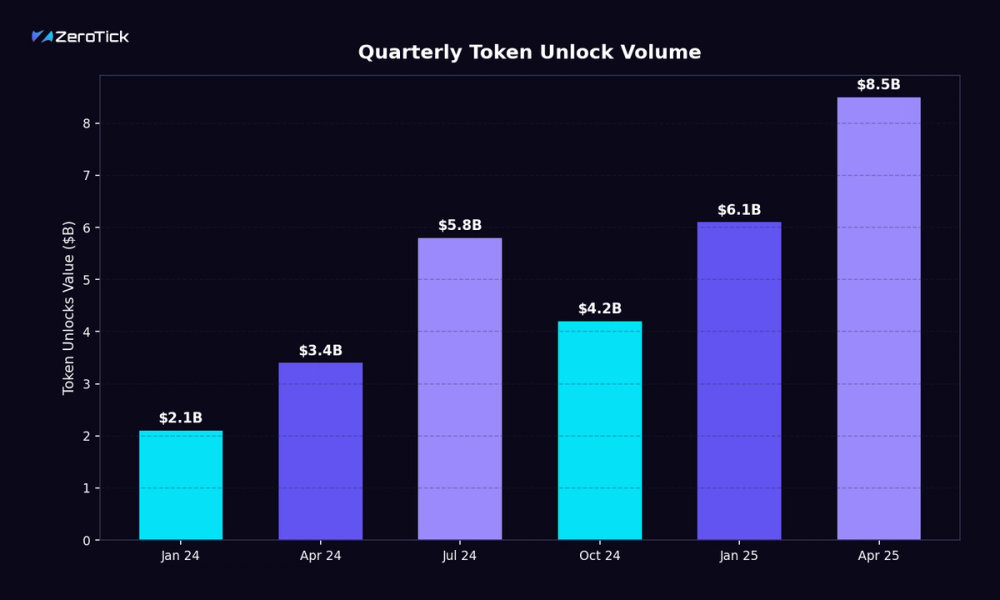
Total unlock volume has grown year over year as more projects enter their vesting cycles, intensifying the need for transparent distribution design.
Source: TokenUnlocks scheduled-unlock dataset
The four principles do not require anything novel. They require treating vesting as part of the launch instead of as a post-launch policy, and treating the contract as the source of truth instead of the marketing deck.
What ZeroTick Offers
ZeroTick V1 ships smart-contract vesting as a built-in part of the Advanced Launch flow. Creators define allocation buckets, cliffs, and release schedules at the same moment they configure the rest of the launch, and the resulting contract runs on its own afterward. Five allocation types are supported out of the box: Marketing, Community, Project Development, Team, and Other. Each type can carry its own cliff period (up to 12 months), its own vesting period (up to 24 months), and its own release interval (weekly, bi-weekly, monthly, bi-monthly, or quarterly). Once configured, the schedule is enforced by the smart contract for the entire lifetime of the allocation. It is not a PDF, and it is not enforced by the team's follow-through.
The design choices behind this flow map directly to the failure modes covered earlier in the article. Equal access: the schedule is public and identical for late buyers and early insiders. Transparency: the vesting contract is visible on-chain from launch onward. Enforcement: the contract releases tokens on its own schedule without requiring trust in the project team. Because vesting is wired into the launch flow rather than bolted on later, a project launching through ZeroTick cannot ship a token with vague or deferred unlock rules. The rules are live the moment the token is.
We built vesting as a core V1 feature because it solves a critical piece of the insider problem right out of the gate. Our V2 roadmap focuses on enhanced MEV resistance through randomized ordering and commit-reveal plus VRF execution ordering, protecting the opening moments of a launch. Together, these two layers address the insider problem from both ends: Anti-Insider, Anti-Bundle, and Advanced Launch caps stop unfair entry, and vesting stops unfair exit.
How It Is Different
The differentiator is not that ZeroTick invented smart-contract vesting. The differentiator is that vesting is part of the Advanced Launch flow itself, configured at the same moment as liquidity, supply, and the rest of the bonding curve protections, rather than treated as a separate post-launch exercise. The contract is generated and deployed at launch time and linked from the launch surface, so any buyer can verify their position before they see the chart.
This design choice connects directly to the rest of the launch protections. Serialized Trade Execution and Anti-Insider, covered in the bundle attack and sniper bot articles, make sure the opening price is not rigged. Vesting done right makes sure the opening price is not undone three months later. Both address the same underlying principle: the rules should be the same for everyone, and the rules should be enforced by code.
Why You Should Care
The next time you evaluate a token, do not start with the launch. Start with the unlock. Look at when insiders become free to sell. Look at whether the schedule is enforced by a smart contract or by a promise. Look at whether the allocation buckets are visible or hidden. Look at whether a single day's unlock represents a meaningful share of average daily volume. If any of those answers are unclear, the launch has already failed a test that matters more than the first hour of price action.
Vesting done right is not glamorous. It is structural, it is boring, and it is the difference between a token that survives its first unlock and one that does not.
Conclusion
Vesting is not a footnote on a tokenomics page. It is the contract that determines whether a launch is fair past block zero, and the choice between off-chain promises and on-chain constraints is the single most consequential vesting decision a project makes. If you want a token to make it through its first unlock with the community intact, the schedule has to be visible, enforceable, and aligned to the actual liquidity of the market it trades in.
Follow the ZeroTick approach at the ZeroTick documentation and the ZeroTick blog.
This article is educational and is not financial advice.