There is a version of the launch-day story where a clever retail buyer clicks buy at exactly the right moment and gets in at the opening price. That version is mostly fiction. In the real environment, the opening price is reached and passed in the time it takes a human hand to move across a trackpad. The buyers at that price are not humans. They are sniper bots, and they have been the decisive actors at memecoin launches for years.
This article is not about how to stop sniper bots. The honest answer is that you cannot. They are a permanent feature of on-chain launches, and any design that pretends otherwise is marketing. The more useful question is what sniper bots do to the bonding curve, why that is the actual harm, why latency races structurally favor whoever has the best infrastructure, and what launch infrastructure can do to limit it.
Why You Cannot Ban the Machines
Every few months a new launch platform promises to be "bot-free". The promise never holds, for structural reasons that are worth understanding.
Bots are just wallets. Any address that can call a swap function can act as a bot, because the swap function does not care whether the caller is a human or a script. Filtering bots would require either identity verification at the contract level, which defeats the point of permissionless trading, or behavioral detection, which bots can evade by mimicking human patterns. The result is that most "anti-bot" mechanisms are either rebranding of purchase caps or security theater.
This is not a cynical take. It is what the data shows. Research across Dune Analytics bot dashboards and coverage from Messari indicates that Telegram trading bots and similar automation now route a meaningful share of all DEX volume, and that share has grown steadily as launch formats proliferate. Bots are not an edge case in the market. They are the median execution path.
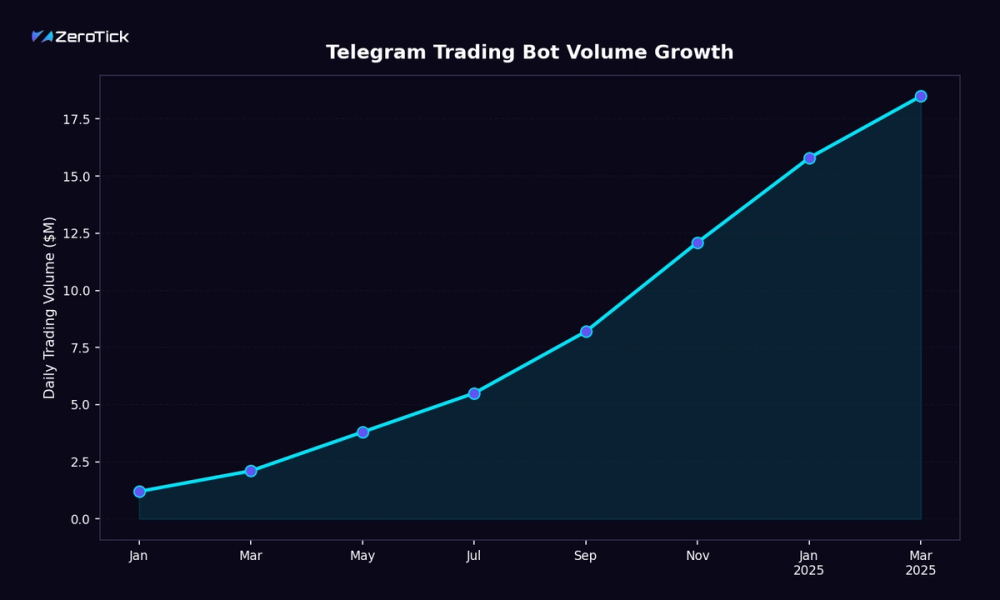
Telegram trading bots now route a material share of all DEX volume, making automated execution the default rather than the exception.
Source: Dune Analytics bot dashboards
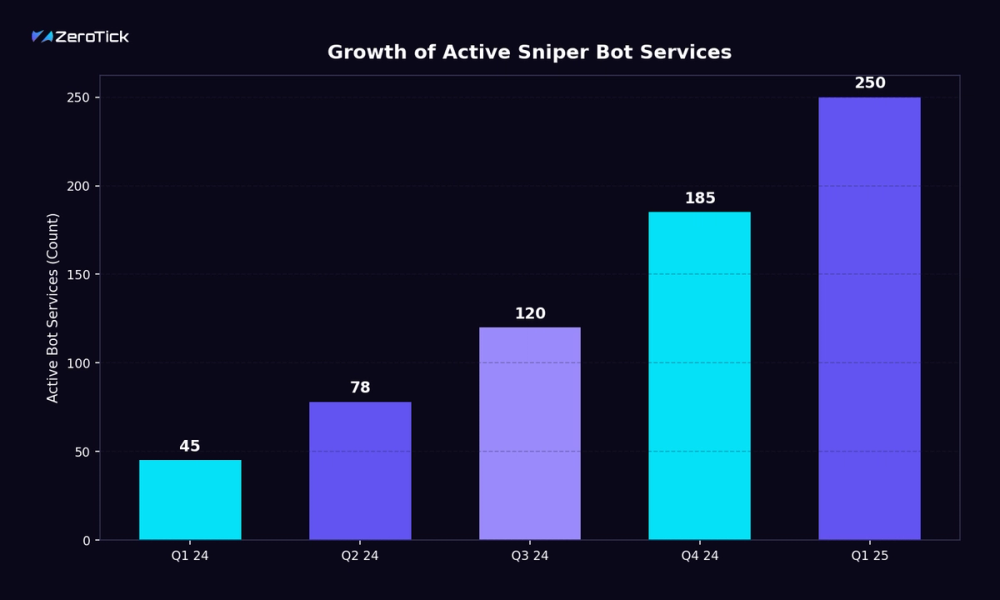
The trading-bot market has expanded steadily, with no sign of slowdown as launch formats proliferate.
Source: Messari, bot platform disclosures
Given that bots cannot be banned, the practical question becomes: what do they do that actually hurts, and which parts of that harm can be engineered away?
Latency Races Favor Infrastructure, Not Skill
Before getting to the curve itself, it is worth understanding why retail loses these races even when retail tries hard. The race is not won by being smart or by clicking fast. It is won by being closer to the validator.
A modern sniper operation looks like a small high-frequency trading firm. The bot itself is the visible part, but the meaningful infrastructure sits behind it: a validator-colocated node, a private RPC connection, a custom mempool listener, and a path to a friendly block builder. Each layer trims latency, and the layers compound. By the time a public buyer's swap reaches a generic node and then propagates to the network, the colocated bot has already submitted, simulated, and confirmed.
This is the structural reason "fast clicking" never wins. The latency gap between an average user's connection and a colocated bot is typically several hundred milliseconds, sometimes more, and the curve walks past the opening price within the first few of those. No human reflex closes the gap. Even users running their own bot from a generic VPS are at a disadvantage to operations running on dedicated hardware near a validator. Latency is a paying market, and the actors who pay the most win.
The implication is that asking retail to compete on speed is asking them to lose. Any serious launch defense has to be a rule, not a race. Rules apply equally regardless of who is connected to which node. Races reward whoever spent the most on infrastructure. A fair launch chooses rules.
The Real Harm: Bonding Curve Distortion
On an automated market maker, the opening moments of a launch are a walk along the bonding curve. Each purchase moves the price along a deterministic function of supply, and the earlier you buy, the lower your price. This is a feature. It rewards people who are willing to buy when liquidity is thin.
The problem is what happens when bots compress the walk. Instead of retail buyers distributing their purchases across the first seconds or minutes of the launch, automated traders compress those purchases into milliseconds. The curve moves so fast that any human entering even a few blocks later is buying at a price several standard deviations away from the opening.
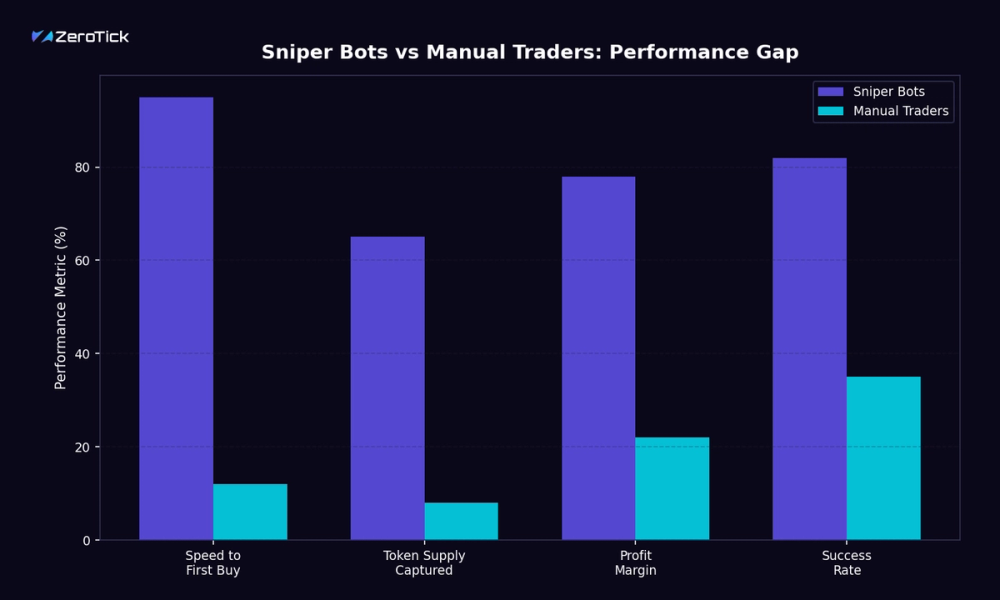
Median bot execution latency is an order of magnitude faster than human reaction time, giving automated actors a structural advantage at launch.
Source: DEX telemetry, research compilations
The math of the harm is worth seeing concretely. On a typical AMM curve, the first one percent of supply consumed moves the price by some delta D1, and the next nine percent move it by another delta D2 where D2 is several times larger than D1 because of the curve's shape. When bots consume the first ten percent in milliseconds, the average human entering at the eleventh percent is paying not the opening price but something closer to D1 plus D2 above it. They are not buying at the opening. They are buying at the back end of a walk they had no chance to participate in. From the retail buyer's perspective, the harm is not that bots exist. The harm is that by the time the buyer actually has an opportunity to participate, the curve has already been walked for them.
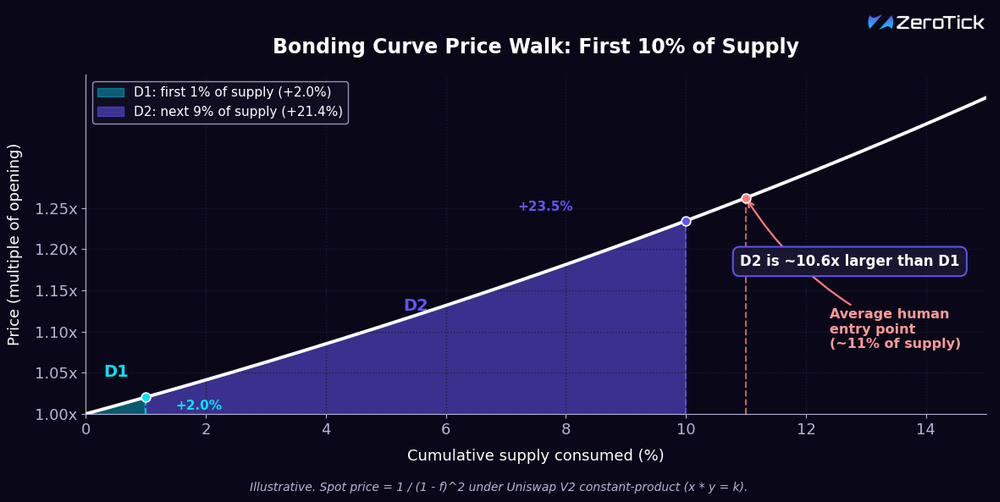
This reframing matters because it suggests a different class of fix. You cannot make the bot slower. You can change the shape of the curve during the opening window so that the bot cannot compress it as aggressively.
What Actually Limits the Harm
Three mechanisms show up in launch designs that meaningfully reduce bonding curve distortion from bots.
The first is per-wallet and per-transaction caps during a protected launch window. If a single bot cannot buy more than a small fraction of supply in the first N blocks, the amount of curve movement that any one bot can cause is bounded. The bot still wins its small allocation, but the opening curve moves more gradually, leaving room for additional participants at reasonable prices. The same caps that defend against bundle attacks and whale concentration at launch do double duty here, because the underlying property they enforce is the same: no participant can take a dominant share of the opening block.
The second is transaction pacing on the opening block. Instead of allowing unlimited swap transactions to execute in the first block, the protocol enforces a maximum rate of swap throughput during the opening window. This is effectively a speed limit on the curve. Bots still participate, but the curve can only move as fast as the pacing rule permits.
The third, and strongest, is cryptographic ordering of opening transactions. If the sequence of buys in the opening window is randomized by a VRF or protected by commit-reveal, then bots cannot guarantee themselves first position. They still participate. They just do not have a structural advantage over any other participant. This is the territory our V2 MEV article covers.
Notice what none of these mechanisms do. None of them try to detect or ban bots. They all accept that bots will be present and focus on limiting the shape of the curve during the window where that presence matters most. This is a much more honest framing than "bot-free launches", and it is also a more effective one.
How ZeroTick Fits
ZeroTick's V1 launch framework attacks sniper distortion with a stack of protections that work together during the bonding curve phase. Every launch runs Serialized Trade Execution by default, which pipes every purchase through the contract one at a time. Because the price on the curve updates between every trade, a sniper cannot lock in a large position at the initial price in a single atomic call, and the serialization gives human transactions a real chance to interleave with bot activity rather than being pushed to the back of the walk. Anti-Insider protection sits underneath that default: the contract address stays hidden until the exact moment trading goes live across all currently supported chains, so no sniper can pre-stage transactions against a known address.
Creators using Advanced Launch can stack optional protections on top of the default. Buy Limits cap each wallet's purchase in USD, which directly constrains how much of the early curve a single sniper wallet can consume before it has to stop buying. Anti-Whale limits total token accumulation per wallet across the entire bonding curve phase, so even a sniper running many sequential buys cannot corner the supply. Anti-Bot blocks automated script purchases during the bonding curve phase. Quick Launch users get Serialized Trade Execution and an optional buy limit without having to configure anything else. Every protection is enforced at the smart-contract level for the entire bonding curve phase and cannot be changed mid-launch.
A note on what "Anti-Bot" means at ZeroTick, because the phrase is used loosely across the industry. The scope is specifically the bonding curve phase during price discovery. The claim is not that bots have been eliminated from the chain. It is that their aggregate impact on the opening price walk is bounded by a stack of protections, each of which removes a different advantage bots rely on. No single layer does the work on its own. The combination is what makes the claim credible.
On V1, that stack has five components operating together during the bonding curve phase, and each one shuts down a different attack surface. Anti-Insider removes the pre-launch information advantage: the contract address stays hidden until the exact moment trading goes live, across all currently supported chains simultaneously, so no bot can pre-stage transactions against a known address or race a staggered reveal. Serialized Trade Execution removes the atomic-bundling advantage: the contract forbids multi-wallet calls inside a single transaction, so a bot cannot sweep the cheap end of the curve in one call, and because the price updates between every trade, sequential bot buys pay incrementally more with each one. Buy Limits remove the single-wallet volume advantage by capping per-purchase USD exposure, which constrains how much of the early curve any one wallet can consume before it has to stop buying. Anti-Whale removes the total-accumulation advantage by capping how many tokens a single wallet can hold across the entire bonding curve phase, so even a bot running many sequential buys cannot corner the supply. Anti-Bot removes the automated-purchase surface itself by blocking script purchases from the bonding curve contract outright. Each layer on its own can be worked around. All five stacked together turn every remaining path a bot could take into a slower and more expensive one than a human pressing a button.
V2 is designed to harden the weakest remaining assumption in that stack: deterministic ordering. Even with serialized execution, a bot that sees a pending transaction in the public mempool can still reason about where its own transaction will land relative to it and react accordingly. The two V2 items on the public roadmap close that gap specifically for the bonding curve phase. Enhanced MEV resistance via randomized ordering makes submission order probabilistic rather than deterministic, so a bot can no longer compute its expected position in the queue. Advanced execution ordering replaces Anti-Bundle with commit-reveal intent hiding and VRF-randomized execution, which hides trade intent from the mempool until the moment of execution and then assigns slots via verifiable randomness. When V2 ships, a bot trying to distort the opening curve no longer knows what to race against, and even if it could, its position in the queue is not something it controls.
Once a token graduates from the bonding curve to a third-party DEX, bonding curve protections are removed and standard DEX trading rules apply. That boundary is deliberate. The bonding curve is where compression causes the most harm, because the price walk is steep and early participation decides retail entry, and it is where the smart contract has the most control over execution. Outside the bonding curve, bots become a broader market problem no single platform can solve alone. Inside it, ZeroTick's stated goal is the one above: bound bot impact layer by layer, across V1 today and V2 once the research work is production-ready, until retail participation at the opening price is actually possible.
Transparency closes the loop. Every Marketplace project card surfaces a real-time Sniper Holding percentage alongside Bundler Holding, Top 10 Holders, Insider Holding, and Dev Holding metrics, so a user can see the actual distribution outcome before buying. High concentration in any of those buckets is a visible warning signal. V2 on the public roadmap adds the next layer by replacing serialized execution with commit-reveal intent hiding and VRF-randomized ordering, which would remove the structural value of being fastest altogether. V2 remains in active research with no public timeline. This article is educational content, not financial or investment advice.
The goal across V1 and V2 is not to create a launch environment where bots cannot exist. It is to create an environment where bots can exist without deciding the outcome. A fair launch is not one with no bots. It is one where the bonding curve walks at a pace a human can plausibly participate in, and where the opening allocation is not captured by whichever wallet happens to be fastest.
Conclusion
Sniper bots are not the enemy. The compression of the opening curve is. When a launch platform tells you it has banned bots, be skeptical. When a launch platform tells you it has bounded what bots can do to the opening price, that is a design you can actually verify.
The next time you evaluate a launch, stop asking whether bots were present. Ask how quickly the price curve moved in the first minute. Ask whether there were per-wallet caps. Ask whether the opening window was paced. Those answers describe the real shape of the launch in a way that "anti-bot" branding never will.
Follow the ZeroTick approach at the ZeroTick documentation and the ZeroTick blog. This article is educational and is not financial advice.