Beyond Serialization: Commit-Reveal and VRF for MEV-Resistant Trading
The first wave of MEV defense asked a straightforward question: what if searchers could not see your trade before it landed? Private relays, encrypted mempools, and order-flow auctions all aimed at that single property, and they made real progress. But hiding a trade from the public mempool only delays the problem. The moment the transaction reaches a builder or validator, the question of who gets to order it comes back.
That is why the research frontier has moved past pure privacy toward mechanisms that attack the problem at its economic root. Commit-reveal submission and verifiable random ordering are two of the most promising primitives in that next wave. Together they try to make transaction sequencing neither observable nor purchasable, and the underlying move they perform is the shift from deterministic to probabilistic ordering that the MEV flagship article walks through in detail.
This article explains how both mechanisms work, where they fit in the broader MEV defense stack, why their combination is what closes the gap, and how ZeroTick is researching them as part of its V2 roadmap.
The Limits of Private Mempools
Private order flow is the dominant MEV defense in production today. When you submit a trade through services like MEV-Share or a private RPC, it skips the public mempool and goes directly to a trusted block builder. Searchers cannot sandwich a transaction they cannot see.
This approach works for the specific attack it was designed to stop. Research from Flashbots and independent analysis from EigenPhi both show that private flow has measurably reduced sandwich exposure for participating users. The defense is real.
But it ships with three structural compromises. The first is trust. You are relying on the builder and the relay to behave honestly. If either is compromised, colludes, or is coerced, the protection dissolves. The second is competitive access. Private order flow still has to reach a block eventually, and the builders who route it have a front-row seat to pricing information that ordinary users do not. The third is partial coverage. Even if your swap avoids the public mempool, arbitrage between venues and across chains continues unaffected, and liquidations are still raced.
There is also a deeper problem. Private mempools change who can see a trade, but they do not change the rule that orders are deterministically sequenced once they reach a block. As long as the builder retains discretion over position, the economic surface for extraction is intact. To close that surface, the research community has converged on two complementary primitives: commit-reveal and verifiable randomness.
Why Deterministic Ordering Is the Real Adversary
The cleanest way to think about MEV is as a function of how predictable transaction order is. A deterministic ordering rule, where the builder picks the sequence to maximize their own revenue, produces a calculable expected value for any extraction strategy. Calculable EV is what turns ordering into an auction, and what turns sandwich attacks, liquidation races, and most other MEV categories into businesses.
Probabilistic ordering changes the variable the auction depends on. When the position your trade lands in is the output of a process no one can compute in advance, the bid for any specific position drops to roughly zero, because there is no longer anything for the bid to purchase. The searcher does not stop searching. They just stop having something to bid on. This is why probabilistic ordering is not a marginal improvement on private mempools. It is a different category of defense entirely, and it is the design move that the next two sections build on.
How Commit-Reveal Works
Commit-reveal is a cryptographic protocol borrowed from voting systems, online auctions, and academic game theory. It splits a submission into two phases so that no one, including the block producer, can read the contents of a transaction until the window for manipulating it has closed.
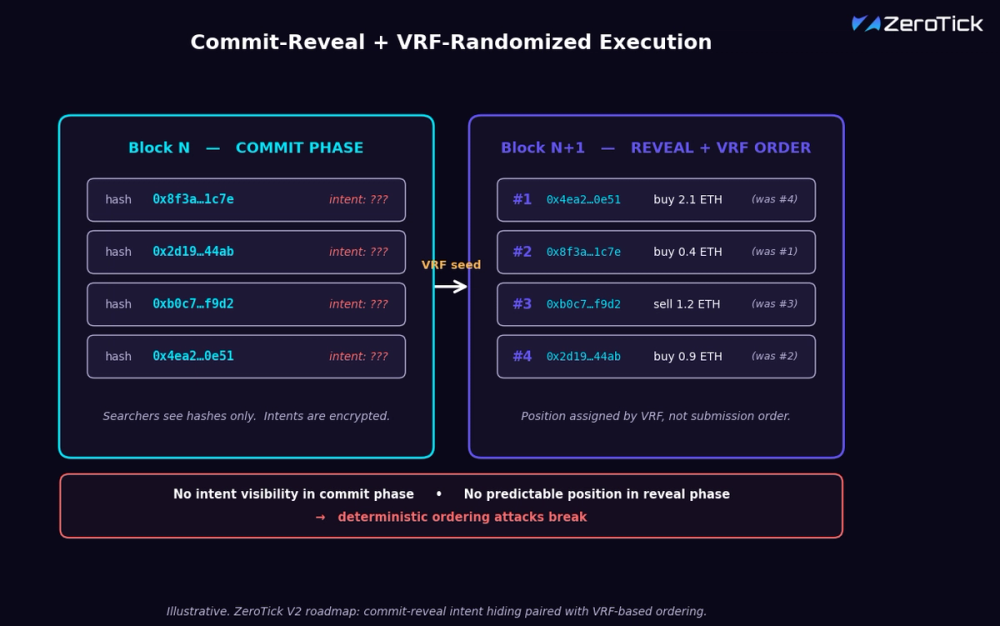
In the commit phase, a trader sends a cryptographic commitment to their trade. A commitment is typically a hash of the full order plus a random salt. It reveals nothing about the underlying transaction but permanently binds the sender to it. The commitment lands in a block. Searchers see that a trade exists. They cannot see what it is.
In the reveal phase, after the commit window closes, the trader publishes the original transaction and the salt. Anyone can recompute the hash and confirm it matches the earlier commitment. If it matches, the trade is valid and executes. If it does not, the commitment is discarded.
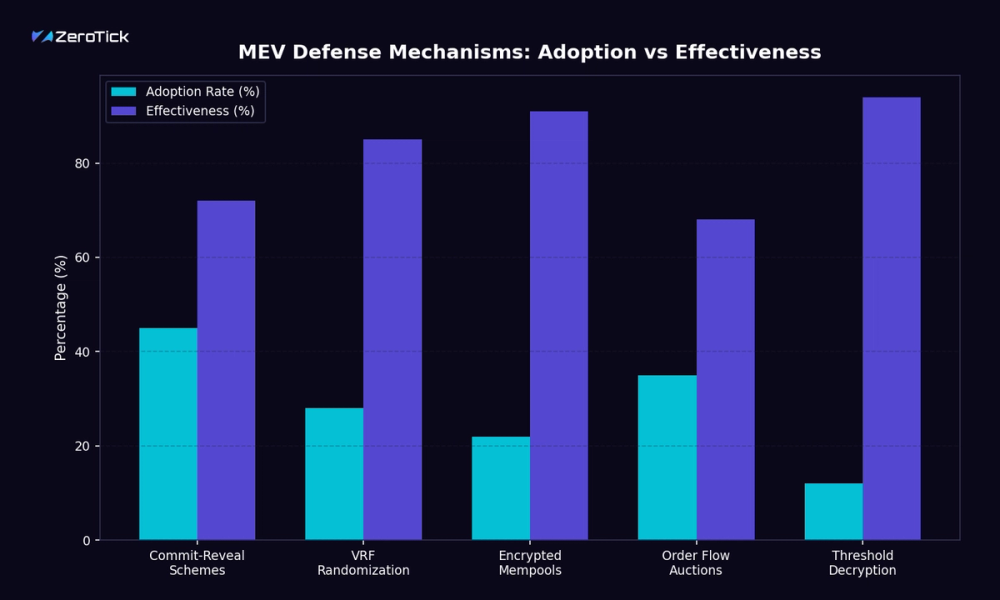
MEV defenses have evolved from private relays toward cryptographic ordering, with commit-reveal and VRF schemes representing the current research frontier.
Source: Flashbots research, academic MEV surveys
Because the content is hidden during the window in which ordering matters, there is nothing for a searcher to front-run. Sandwich attacks require knowing the direction and size of a victim's trade. Commit-reveal denies both.
The mechanism is not free, and the production challenges are real. The first is latency. A two-step protocol takes longer than a one-step one, and on chains where users expect sub-second confirmation, even an extra block of delay can feel like friction. The second is liveness. A user who commits and then disconnects before the reveal phase should not be silently penalized, because that would invite a class of grief attacks where adversaries flood the commit phase to get their commits orphaned. The third is griefing resistance. A pure commit-reveal scheme can be abused by submitting commits that the sender never intends to reveal, wasting block space and degrading throughput. Stake-based commitments, where the sender locks collateral that is forfeited if the reveal is missed, are one of the standard answers.
The most interesting variant is threshold encryption. Instead of relying on the user to publish the reveal, the encrypted trade is split among a set of decentralized key holders, and only a threshold subset can decrypt it after a defined block has been reached. This removes the liveness problem entirely, because the user no longer has to be online. It is the approach projects like Shutter Network and Osmosis have publicly explored, and it is an active area of research with multiple production-grade implementations under construction.
How VRF-Based Ordering Works
Commit-reveal protects the content of a trade. VRF-based ordering protects the sequence in which trades execute.
A verifiable random function is a cryptographic primitive that lets a specific party generate a random-looking output together with a proof that the output was computed correctly. The defining property is that the output is unpredictable before it is computed, but verifiable after the fact. You cannot bias it. You cannot pre-compute it. And you cannot deny having produced it.
When applied to transaction ordering, VRF turns block position from a commodity into a lottery. Instead of the block builder or the highest-bidding searcher deciding the order, a VRF over the set of eligible transactions assigns positions in a way that no one can influence. If you cannot choose where your trade lands, and no one can guarantee where any other trade lands, there is nothing to bid on. The math of MEV extraction collapses, because every extraction strategy depended on knowing where the extracted-from trade was going to land.
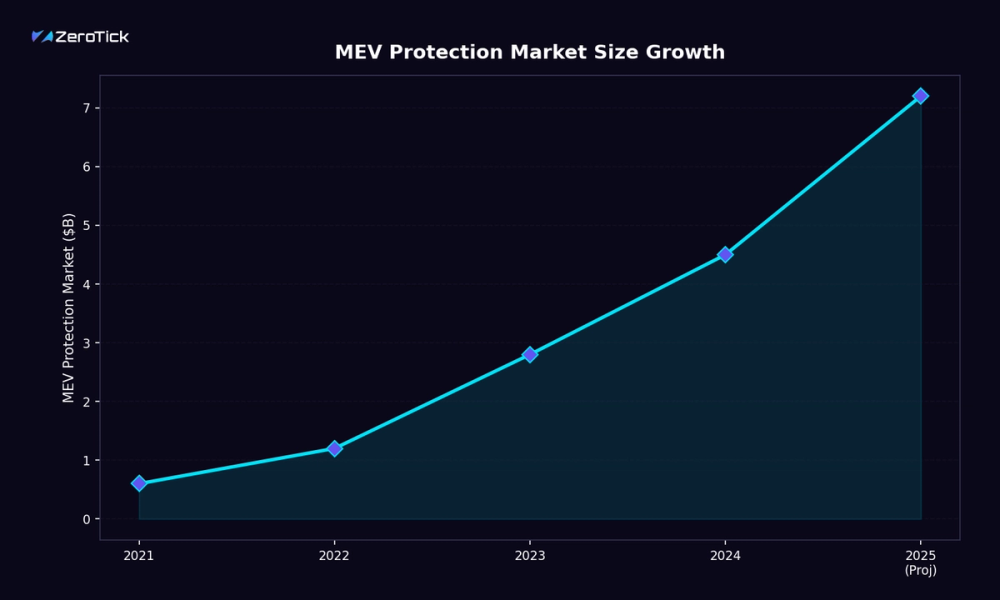
Estimated annual MEV extracted has compounded since 2020, sustaining demand for stronger ordering guarantees at the protocol layer.
Source: Flashbots MEV-Explore, EigenPhi
The trade-off is that verifiable randomness is only as good as its source. A biased VRF is worse than no randomness at all. Production systems tend to lean on well-studied constructions like Chainlink VRF or drand, which provide independent verifiability and battle-tested implementations. The research question is not whether good VRF exists. It is how to wire it into a trading venue without introducing new bottlenecks, new trust assumptions, or new failure modes when the randomness beacon itself stalls or is censored.
Why the Two Primitives Belong Together
Commit-reveal and VRF solve different halves of the same problem, and neither is fully protective on its own.
Commit-reveal without fair ordering still lets a malicious block producer choose which commitments to include and in what order. The content is hidden, but position in the block is still a knob the builder can turn. A sophisticated adversary can sometimes infer enough about a trade from off-chain context, like a wallet's historical behavior or the timing of related transactions, to front-run it even without seeing the bytes.
VRF-based ordering without commit-reveal still leaks trade intent during the window between submission and execution. Anyone reading the mempool can see what the trades are. They just cannot guarantee their own order around them. This reduces extractable value significantly, but does not eliminate it, because a determined adversary can still stuff the candidate set with their own transactions and hope that the lottery places them in profitable positions.
Combine the two and both vectors close at once. Traders commit to hidden trades. The set of committed trades in a given block is then ordered by a VRF whose output no one can predict or bias. By the time a trade is visible to the network, it has already been assigned an unbiased position. The adversary cannot front-run what they cannot read, and they cannot purchase a position they cannot select. Deterministic ordering becomes probabilistic ordering, and the EV calculation that drives extraction collapses.
This is the design envelope that modern MEV-resistant venues tend to converge on. The details vary by team, but the core insight is the same: privacy plus unbiasable ordering, not one or the other. The same logic applies to launch protections, which is why our bundle attack article treats VRF-style ordering of block zero as the strongest available defense for opening supply.
Where ZeroTick Fits
ZeroTick's public roadmap places commit-reveal intent hiding and VRF-randomized execution at the center of its V2 protection layer. Two items are listed by name under V2: enhanced MEV resistance that upgrades from serialized execution to randomized ordering, making MEV attacks probabilistic rather than deterministic, and advanced execution ordering that replaces the V1 Anti-Bundle protection with commit-reveal intent hiding and VRF-randomized execution. Those two items line up exactly with the pairing this article describes.
V1 already ships the baseline that V2 is designed to replace. Every bonding curve launch on ZeroTick runs under Serialized Trade Execution today, which forces one transaction at a time and prevents multi-wallet bundles from consuming the cheap end of the curve in a single atomic call. Serialized execution closes the deterministic-ordering gap at the launch layer without requiring new cryptographic primitives, and it runs alongside always-on Anti-Insider protection that hides the contract address until the exact moment trading goes live. It is, effectively, the V1 answer to the problem this article frames, and V2 is the plan for raising that ceiling once the research work is production-ready.
None of the V2 mechanisms described here are live today. V2 remains in active research with no public timeline. The specific cryptographic choices and liveness assumptions are still being evaluated across the chains ZeroTick currently supports, and this article reflects where the research stands in 2026 rather than a finalized product spec. This content is educational, not financial or investment advice.
Conclusion
MEV defense is not a single invention. It is a layered stack that keeps adapting as searchers adapt. Private mempools were layer one. Commit-reveal and VRF-based ordering are the next two layers being researched and tested today, and the deeper move underneath them is the shift from deterministic to probabilistic ordering as the default rule of the venue.
For traders, the practical takeaway is simple. When you evaluate a decentralized trading venue, ask whether its protections are behavioral or cryptographic. Behavioral protections depend on someone playing nicely. Cryptographic protections do not. The future of fair trading belongs to the second category.
Follow the research at the ZeroTick blog and the ZeroTick documentation. This article is educational and is not financial advice.