
Every time you click swap on a decentralized exchange, a silent auction begins for the right to rearrange, insert, or replay transactions around yours. That auction is where Maximal Extractable Value lives, and the traders who end up paying for it rarely realize it happened.
MEV is the value sophisticated actors can extract from users by reordering, inserting, or censoring transactions inside a block. It is not a bug in any single protocol. It is an emergent property of how public blockchains process trades, and it has become one of the largest wealth transfers in crypto. By conservative estimates, cumulative MEV extraction across major chains sits in the billions of dollars, with Ethereum alone accounting for the lion's share.
This article unpacks what MEV is, where it comes from, why the problem resists simple fixes, and what a credible MEV-resistant trading venue should look like. It also lays out how ZeroTick is approaching the problem, and why the most promising defenses move from deterministic ordering to probabilistic ordering as the central design move.
Where MEV Comes From
The first thing to understand about MEV is that it is not theft in the traditional sense. Nothing about a sandwich attack is illegal, and nothing about arbitrage violates a smart contract. The extractor simply plays by the rules of a public mempool better than everyone else.
A public mempool is a waiting room. When you submit a trade, it sits there for anyone to read before it lands in a block. Specialized actors, called searchers, scan the mempool in real time, looking for profitable patterns. When they find one, they assemble bundles of their own transactions and pay block builders or validators to place those bundles in a specific order. The result is a multi-billion-dollar marketplace for transaction ordering, and the people who lose the most are the ones who never knew they were bidding.
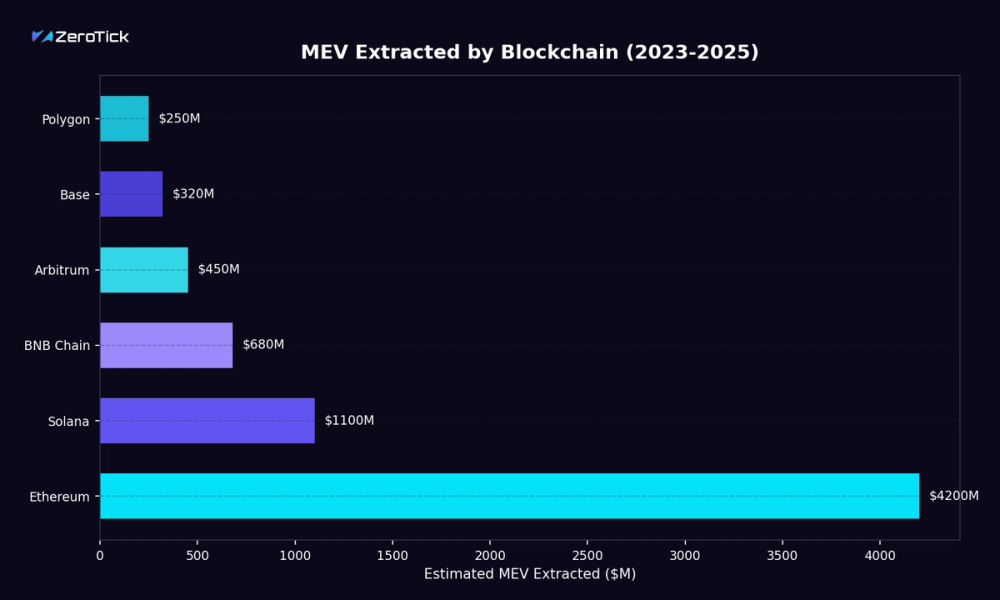
Ethereum dominates MEV extraction, but Solana and L2s now account for a material share as cross-chain infrastructure matures.
Source: Flashbots, EigenPhi, Jito Labs (2023-2025)
Research from Flashbots shows extraction is not evenly distributed. Ethereum has historically been the epicenter, but Solana's high throughput and low latency created an entirely new class of MEV opportunities, tracked in detail by teams like Jito Labs. Layer 2 rollups have not solved the problem. They have changed its flavor, often concentrating ordering power in a single sequencer that becomes the new chokepoint.
The actors driving this market are not faceless. A small cohort of professional searchers and a smaller set of specialized block builders capture the majority of profit, and the gap between the top and the long tail is widening with each cycle. The economics reward concentration. Faster infrastructure produces more profit, more profit funds faster infrastructure, and the resulting feedback loop has turned MEV into one of the most lopsided participation curves in the entire on-chain economy.
The Three Attacks That Matter
Three attack patterns dominate MEV activity, and together they explain most of the extracted value.
Sandwich Attacks
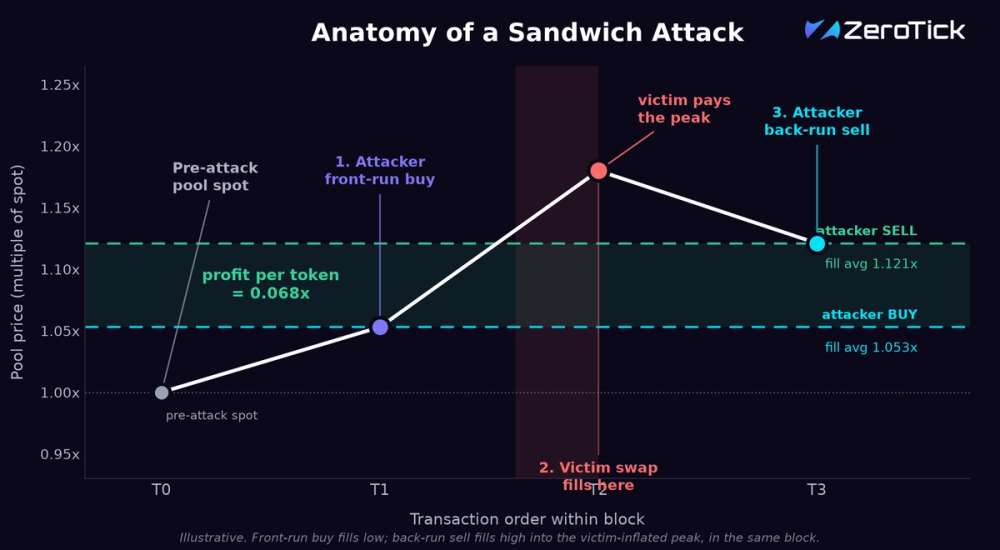
A sandwich attack wraps a victim's trade between two of the attacker's own. The attacker spots your pending swap, buys the asset in front of you to push the price up, lets your swap execute at the worse price, then sells into the pump you just created. You pay slippage. They pocket the difference.
Sandwich attacks are especially brutal on automated market makers, where a single large trade moves price along a predictable curve. The bigger your trade, the juicier the target.
Arbitrage
Arbitrage is the most defensible form of MEV, because it keeps prices in sync across venues. When the same asset trades at different prices on two exchanges, a searcher can buy low on one and sell high on the other inside a single atomic transaction. This is economically useful. It tightens spreads and improves price discovery.
The problem is that arbitrage profits compete directly with liquidity providers and regular traders. Every dollar of arbitrage MEV is a dollar that did not go to the LP who took on the price risk, or to the trader who was first to notice the mispricing.
Liquidation Races
When a lending position falls below its collateral threshold, anyone can call the liquidation function and claim a bonus. On paper, this is a healthy mechanism. In practice it turns into a gas war. Searchers race to front-run each other, burning fees, and the borrower often ends up paying for the churn through worse execution.
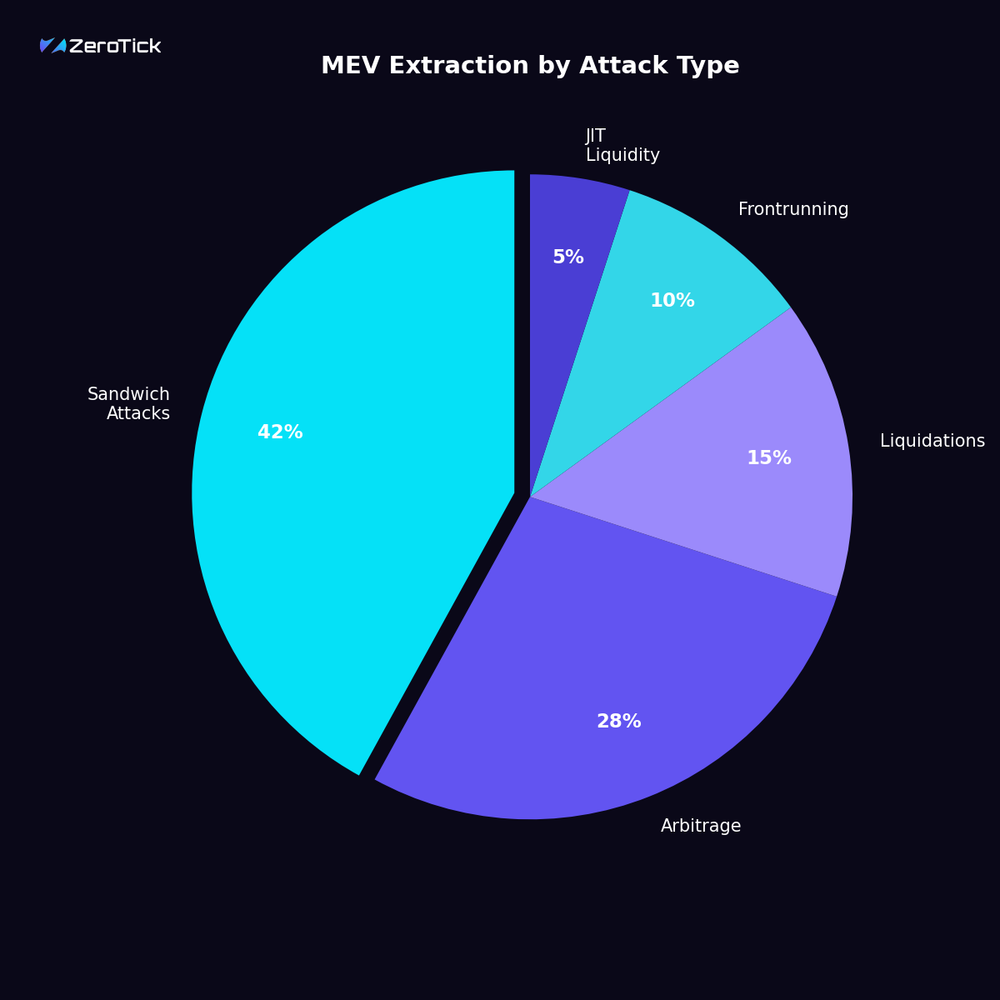
Sandwich attacks and arbitrage together represent roughly 70% of all extracted value, making ordering manipulation the central problem to solve.
Source: EigenPhi, Flashbots MEV-Explore
Across the three categories, sandwich attacks and arbitrage together represent roughly 70% of all extracted value according to research published by EigenPhi, which makes ordering manipulation the central problem any MEV-resistant design has to solve.
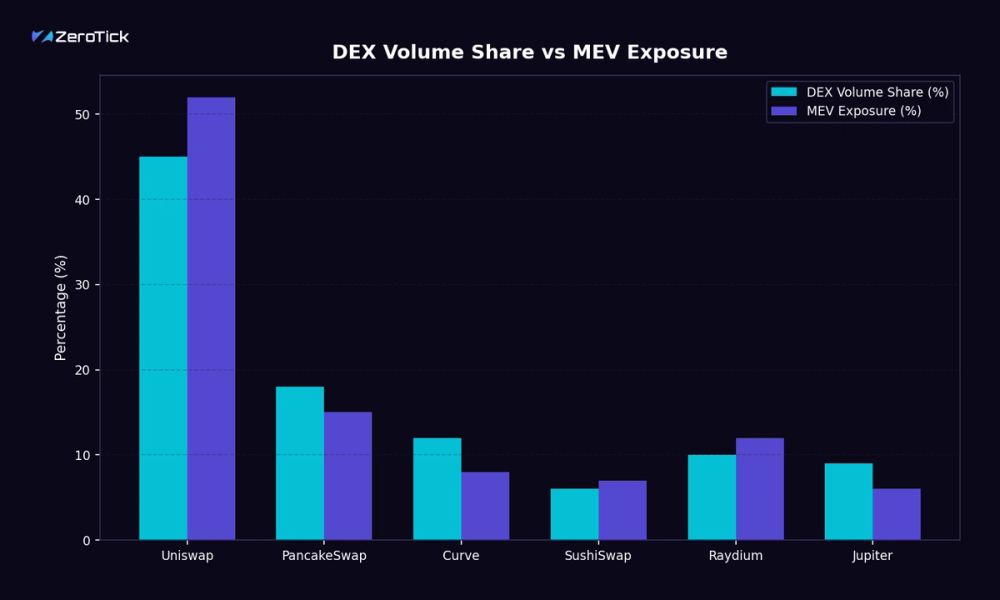
As on-chain DEX market share has grown, MEV extraction has grown with it, underscoring that the problem scales with adoption rather than shrinking.
Source: Flashbots, DEX analytics
Why Profit Concentrates Among Searchers
The concentration of MEV profit among a small group of professional actors is not incidental. It is structural, and it is what makes the problem so durable.
A searcher is essentially an arbitrage business. Better tooling means faster simulation. Faster simulation means more opportunities captured. More opportunities means more capital. More capital means more compute, more direct relationships with builders, and more researchers paid to find the next class of extractable patterns. Once the loop spins up, the gap between the top searchers and everyone else compounds at a rate ordinary participants cannot match.
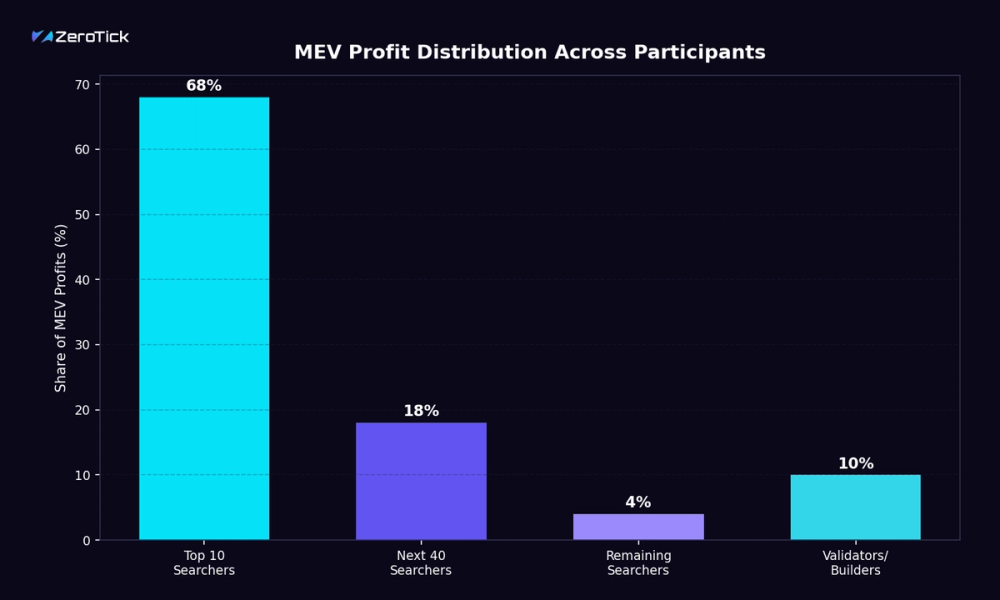
A small cohort of professional searchers captures the vast majority of MEV profits, concentrating an adversarial advantage over ordinary traders.
Source: Flashbots, MEV-Explore dashboards
The economic implication is uncomfortable. The small set of actors with the most to lose from a successful MEV defense is also the set with the most resources to evade one. Every new defense creates a new edge for whoever adapts to it first. This is why MEV is not solved by a single clever mechanism. It is solved, if it is solved at all, by a stack of defenses that close off the categories of advantage rather than chase individual exploits.
Why the Problem Resists Simple Fixes
If MEV were easy to stop, it would already be stopped. The difficulty is that the forces creating it are the same forces that make public blockchains work. You need a public mempool so anyone can submit transactions without permission. You need ordered blocks so the network can reach consensus. You need searchers and builders so blocks get filled efficiently. Remove any one of these and you either centralize the system or break it.
Early defenses focused on hiding transactions from the public mempool by sending them directly to trusted builders. This helps with front-running in specific cases, but it introduces a new trust assumption: the builder. If the builder is compromised or colludes, the protection evaporates. It also leaves arbitrage and liquidation races completely untouched, because both depend on visibility of pool state rather than on the mempool itself.
The deeper reason simple fixes fail is that MEV is a property of deterministic ordering. As long as the order in which transactions execute can be computed, predicted, or purchased, there is something for an extractor to bid on. Defenses that hide content help. Defenses that break the predictability of order help more, because they attack the source of the bidding rather than the symptom.
From Deterministic to Probabilistic Ordering
The shift the most promising MEV-resistant designs are converging on is the move from deterministic ordering to probabilistic ordering.
Deterministic ordering is the current default. The block builder decides the sequence, and that sequence is whatever maximizes their revenue inside the rules of the protocol. Because the builder's decision function is observable, searchers can bid for specific positions by paying for them, and the expected value of any extraction strategy becomes a calculable number. Calculable EV is what makes MEV a market.
Probabilistic ordering changes the math. When the order of trades inside a block is determined by a verifiable random function, by a commit-reveal protocol, or by a frequent batch auction that clears at a uniform price, the position your trade lands in is no longer something a builder can sell or a searcher can buy. The bid is not just lower, it collapses, because there is no longer anything for the bid to purchase. A sandwich attack requires being adjacent to the victim's trade. If adjacency is a coin flip, the attack does not pay. If the attack does not pay, the attacker stops trying.
This is the thread our V2 MEV article follows in detail. The core insight is that MEV is a property of how blocks are ordered, and changing the ordering rule is the only intervention powerful enough to address the problem at its root.
What a Credible Defense Looks Like
A serious MEV-resistant trading venue has to do more than route orders through a private relay. It needs to reshape the environment in which transactions become executable. Three design principles tend to show up in the most promising approaches.
The first is pre-trade privacy. If no one can see your order before it is final, no one can sandwich it. Commit-reveal schemes, encrypted mempools, and threshold cryptography all aim at this property. The mechanics differ, but the goal is the same: keep trade intent private until ordering is locked.
The second is fair ordering. Once trades are visible, their sequence should not be up for sale. Verifiable randomness, batch auctions, and frequent-batch clearing all try to eliminate the economic value of being first. If position in the block is not a commodity, there is nothing for searchers to bid on.
The third is transparent post-trade reporting. Users should be able to audit after the fact whether their execution matched what the venue promised. Without that, any protection claim is unverifiable marketing.
Where ZeroTick Fits
ZeroTick treats MEV as a launch-layer problem, not a post-launch complaint. During the bonding curve phase, every token launched on the platform runs under Serialized Trade Execution, which processes every transaction one at a time and prevents the multi-wallet bundling that makes the most profitable extraction possible. The price updates between every trade, so a searcher cannot lock in a large quantity at the initial price inside a single atomic call, and legitimate user transactions can interleave with bot activity instead of being pushed behind it. Serialized execution is enabled by default on both Quick Launch and Advanced Launch and is enforced at the smart-contract level for the entire bonding curve phase.
V1 also removes the earliest MEV surface entirely. Anti-Insider protection is always active and hides the contract address until the exact moment trading goes live, across all currently supported chains simultaneously, so there is no pre-launch window for searchers or insiders to stage transactions against a known address. Creators using Advanced Launch can layer on optional per-wallet Buy Limits, Sell Limits, Anti-Whale accumulation caps, and Anti-Bot filters, each of which narrows a different MEV-adjacent attack surface. Protection status is visible on the Marketplace via green and red indicators, and five real-time holder metrics (Dev, Insider, Sniper, Top 10, Bundler) let any user see the distribution outcome their protection choices produced. The same protected launch logic carries over to the bundle attack and sniper bot failure modes covered elsewhere in this series.
V2 is where ZeroTick moves from serialized execution toward probabilistic ordering. The public roadmap lists two V2 upgrades directly: enhanced MEV resistance via randomized ordering, which makes MEV attacks probabilistic rather than deterministic, and advanced execution ordering that replaces Anti-Bundle with commit-reveal intent hiding and VRF-randomized execution. None of the V2 mechanisms are live today. V2 remains in active research with no public timeline. The reason this architecture matters is not that it makes MEV disappear. Nothing does. It is that it shifts the economic center of gravity away from adversarial reordering and back toward the traders and liquidity providers who take on the real risk.
Conclusion
MEV is not a glitch. It is the predictable consequence of letting anyone watch and reorder trades before they settle. Until a trading venue changes that, every swap you make is implicitly paying a fee to whoever is fastest and most sophisticated at reading the mempool.
The path forward is not one defense but a stack of them: private order submission, fair ordering, and auditable settlement, layered on top of a fundamental shift from deterministic to probabilistic transaction ordering. ZeroTick V1 aims to deliver the first layer, and V2 research is focused on the rest. If you want to follow the work, the ZeroTick documentation and the ZeroTick blog are the best places to track progress.
This article is educational and is not financial advice.